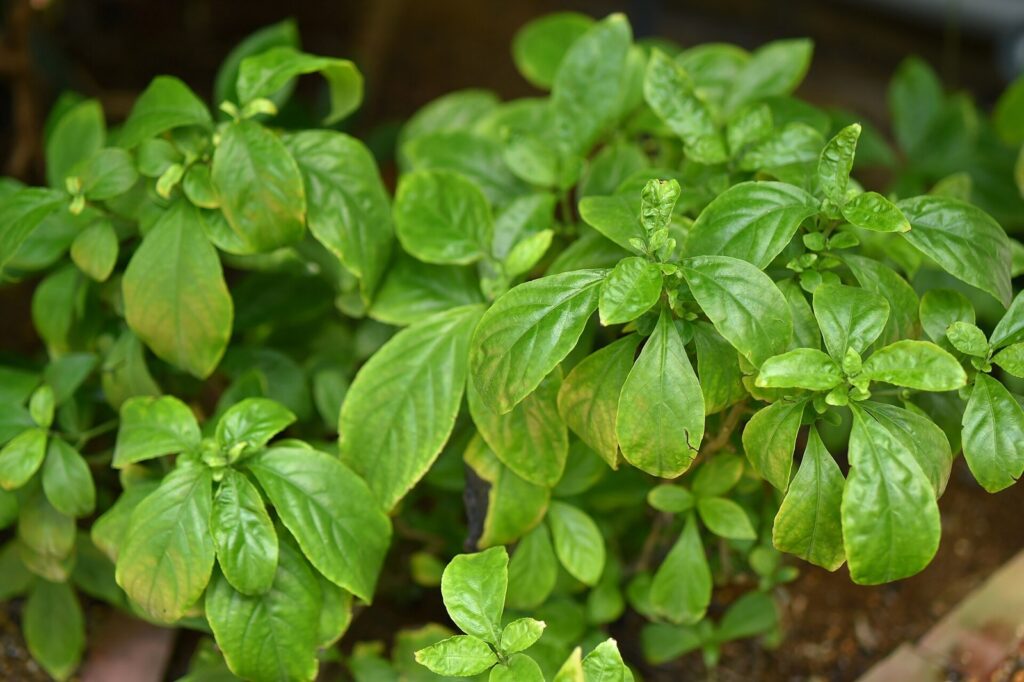
Ryukyu indigo (琉球藍, Ryūkyū ai) is the deep blue dye behind most of Okinawa’s traditional textiles, from bashōfu and bingata to Miyako jōfu and Ryukyu kasuri. It comes from a different plant from mainland Japanese indigo, Strobilanthes cusia, and is made into a precipitated indigo paste called doro-ai (泥藍). Today almost all of it is produced around Izumi in Motobu, northern Okinawa, where its production technique is protected as a Selected Conservation Technique. You can visit and try indigo dyeing with the preservation society there.
This page is part of our guide to Ryukyuan textiles, which compares all of Okinawa’s woven and dyed crafts.
Ryukyu Indigo at a Glance
| Japanese | 琉球藍 (Ryūkyū ai); the plant is リュウキュウアイ; local name ē or yē (エー, イェー) |
| Plant | Strobilanthes cusia (syn. S. flaccidifolius), acanthus family (キツネノマゴ科) |
| Origin | Native to Assam in India; found from India to Indochina, China and Taiwan. In Japan it grows mainly in northern Okinawa Main Island |
| Dye form | Doro-ai (泥藍), a precipitated indigo paste |
| Main producing area | Izumi (伊豆味) and nearby, Motobu Town |
| Protection | Selected Conservation Technique (選定保存技術) “Ryūkyū ai seizō” (琉球藍製造), first selected 11 May 1977; holding group recognised 2002 |
A Different Indigo
The Agency for Cultural Affairs explains that Ryukyu indigo is a different species from the indigo of mainland Japan and has been grown in Okinawa since early times. Mainland Japanese indigo, as made in Tokushima, comes from tade-ai (Persicaria tinctoria), whose dried leaves are fermented for about three months into a composted dye called sukumo (蒅). Ryukyu indigo is instead turned into a wet paste after only a short soak, according to a study by the Okinawa Industrial Technology Center.
The preservation society says the origins of Ryukyu indigo in Okinawa are unclear, but that it is thought to have arrived in about the 14th or 15th century. It has been an essential dye from the Ryukyu Kingdom era to the present.
How Doro-ai Is Made
The Okinawa Industrial Technology Center describes the basic method:
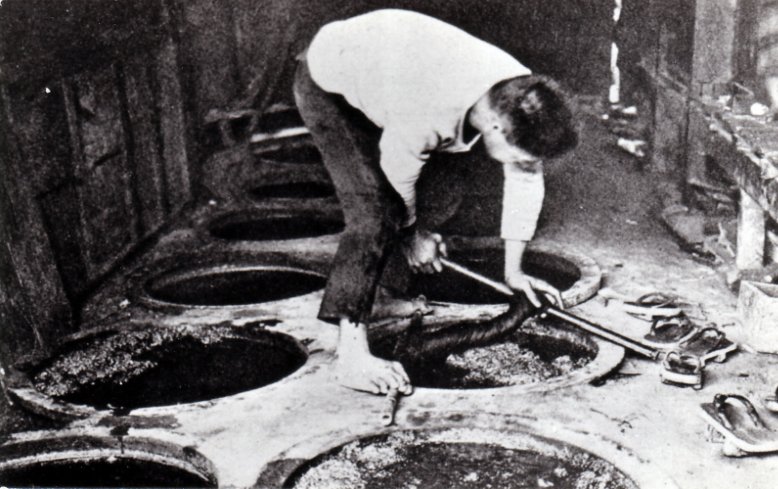
- Soaking: freshly cut Ryukyu indigo is soaked in water for a short time in a large vat (藍壺, ai-tsubo), where it ferments and the dye comes out of the leaves.
- Lime and stirring: slaked lime is added to the liquid, which is then stirred hard, so that the dye, mainly indigo, clumps together and settles.
- Paste: the settled indigo is collected as doro-ai, a muddy paste that dyers then use to prepare their dye vats.
The centre’s study used two round-bottomed vats holding 7.5 tonnes each at an indigo works in Motobu, which gives a sense of the scale. Dyers then ferment the paste in their own vats; Miyako jōfu, for example, is dyed in fermented Ryukyu indigo.
Did you know? In its 2014 study, the Okinawa Industrial Technology Center found that the soaking liquid for Ryukyu indigo contained around a million to ten million microbes per millilitre, many of them lactic acid bacteria that tolerate alkaline conditions.
Protecting the Technique
Because nearly every traditional Okinawan textile depends on it, Ryukyu indigo production was chosen as a national Selected Conservation Technique. The Agency for Cultural Affairs selected it on 11 May 1977 and notes that production had by then shrunk to the area around Izumi in Motobu. The first individual holder, Inoha Seisei (伊野波盛正), was recognised in 1977; his recognition ended on his death in 2019, according to the prefecture.
The Ryukyu Indigo Production Technique Preservation Society (琉球藍製造技術保存会) was founded in 1999 by producers and academics, and was recognised as a holding group for the technique in 2002. The prefecture’s list as of June 2024 gives its representative as Takehara Yasuhiko (嵩原安彦) and its membership as 17. The society trains successors, recruits growers in Motobu and runs indigo-dyeing workshops and events, such as sessions at Ocean Expo Park.
Visit and Try Indigo Dyeing
The Ryukyu Indigo Production Technique Preservation Society has its office inside Mikan no Sato (みかんの里), the Izumi produce centre in Motobu. It offers:
- Facility visit: free, no reservation needed.
- Visit with explanation: about 30 minutes, ¥500 per person, by reservation.
- Visit, explanation and indigo dyeing: about 90 minutes, ¥2,500 per person, by reservation, for groups of five or more only. You dye a handkerchief or a tenugui towel and take it home the same day. Wear clothes that can get dirty.
- Address: 2846-13 Izumi, Motobu Town (本部町字伊豆味2846-13), inside Mikan no Sato
- Phone: 090-6796-5539
- Getting there: about 1 hour 30 minutes by car from Naha Airport, or a 3-minute walk from the Dai-ni Iyagai (第二イヤガイ) bus stop on routes 70 (Bise line) and 76 (Sesoko line).
Opening hours are not published, so contact the society before visiting. Motobu, also home to Ocean Expo Park, is in Northern Okinawa.
Practical details in this section last checked: Oct 2026.
Where You Will See Ryukyu Indigo
The Agency for Cultural Affairs lists bashōfu, bingata, Miyako jōfu, Ryukyu kasuri and tsumugi among the textiles that use Ryukyu indigo. Look for it in the navy grounds of Miyako jōfu and Ryukyu kasuri, the blue of minsā belts, and the indigo shades of bingata and bashōfu.
Frequently Asked Questions
What is Ryukyu indigo?
Ryukyu indigo is a dye made from Strobilanthes cusia, a different plant from mainland Japanese indigo. It is the main blue dye of Okinawa’s traditional textiles.
How is Ryukyu indigo different from Japanese indigo?
Mainland indigo is usually sukumo, made by fermenting dried Persicaria leaves for months. Ryukyu indigo is made by soaking fresh leaves, adding slaked lime and stirring to settle a wet paste called doro-ai.
Where is Ryukyu indigo made?
Mainly around Izumi in Motobu Town, northern Okinawa, where the Agency for Cultural Affairs says production is now concentrated.
Can I try Ryukyu indigo dyeing?
Yes. The Ryukyu Indigo Production Technique Preservation Society in Motobu offers a 90-minute visit and dyeing session for ¥2,500 per person, by reservation and for groups of five or more.
Sources & Further Reading
Facts on this page were checked against these sources. Most are official Japanese-language pages from the prefecture, the Agency for Cultural Affairs, producers’ cooperatives and museums.
Official and preservation society sources
- Agency for Cultural Affairs, Cultural Heritage Online: Ryūkyū ai seizō (Ryukyu indigo production) (official, Japanese)
- Motobu Town: Izumi district (cultural properties) (official, Japanese)
- Okinawa Industrial Technology Center Research Report No. 17 (2014): Microbes in the production of precipitated indigo from Ryukyu indigo and Japanese indigo (official, Japanese, PDF)
- Ryukyu Indigo Production Technique Preservation Society: About the society (Japanese)
- Ryukyu Indigo Production Technique Preservation Society: About Ryukyu indigo (Japanese)
- Ryukyu Indigo Production Technique Preservation Society: Indigo dyeing experience (Japanese)
- Ryukyu Indigo Production Technique Preservation Society: Access (Japanese)
- Okinawa Prefecture: Overview of craft industry policy, FY2024 (Selected Conservation Technique holders as of June 2024) (official, Japanese)
Image credits
- Working indigo vats in Okinawa, before 1946. Photo: pre-war photographer, via Naha City Museum of History archive, public domain, via Wikimedia Commons.
- Ryukyu indigo (Strobilanthes cusia) growing at Mito Botanical Park in Ibaraki, mainland Japan, 2024. Photo: 小石川人晃, CC BY-SA 4.0, via Wikimedia Commons.