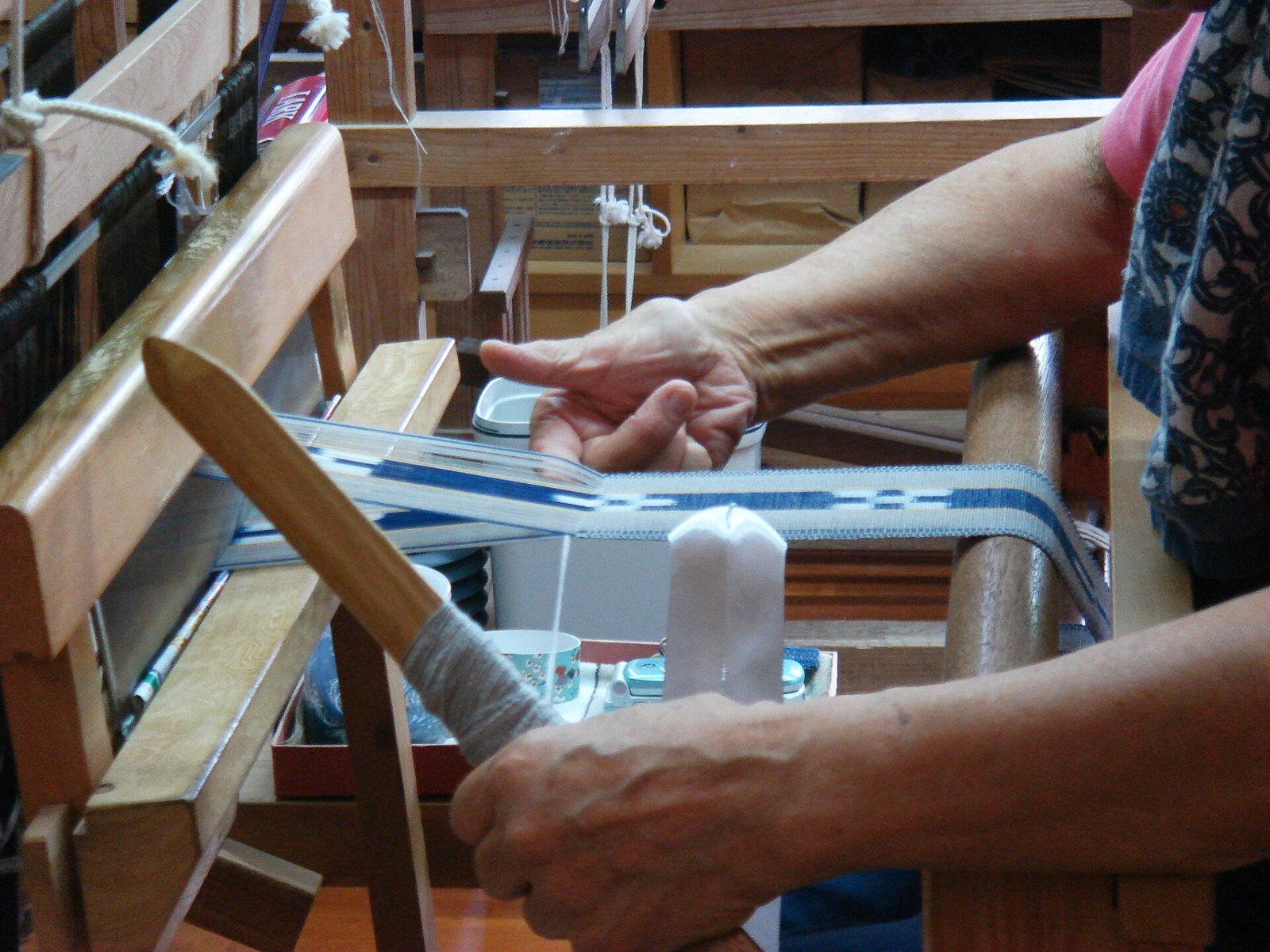
Yaeyama minsā (八重山ミンサー) is the narrow cotton kasuri belt of Ishigaki and Taketomi, instantly recognisable by its row of five squares and four squares. Woven in a warp-ribbed weave and traditionally dyed with indigo, it nearly died out around 1960 but has since become one of Okinawa’s best-loved crafts, made into belts, bags and souvenirs. It was designated a national Traditional Craft, together with Yaeyama jōfu, in 1989. You can see it woven on Ishigaki and on Taketomi Island.
This page is part of our guide to Ryukyuan textiles, which compares all of Okinawa’s woven and dyed crafts.
Yaeyama Minsā at a Glance
| Japanese | 八重山ミンサー (Yaeyama minsā); the belt is also called minsā-fu (みんさー帯) or ubi |
| What it is | A kasuri belt, traditionally 1.5–3 sun wide (about 4.5–9 cm, or 1¾–3½ in); wider single-width obi are now common too |
| Technique | Warp-ribbed weave (経畝織) with kasuri |
| Material and dye | Cotton thread, dyed with indigo, fukugi and other dyes |
| Made in | Ishigaki City and Taketomi Town |
| Designations | Okinawa Prefecture traditional craft product (1974); national Traditional Craft, Ministry of Economy, Trade and Industry, as “Yaeyama jōfu and Yaeyama minsā” (11 April 1989) |
| Cooperatives | Ishigaki City Textile Business Cooperative (founded 1976); Taketomi Town Textile Business Cooperative (founded 18 January 1989) |
The Five-and-Four Pattern
The best-known feature of Yaeyama minsā is its kasuri of five squares and four squares. The Ishigaki maker Azamiya explains that the pattern carries the wish itsu no yo made mo, suenagaku (いつの世までも、末永く), “for ever and always”, playing on the words for five (itsu) and four (yo). Originally it was a narrow belt dyed with indigo. Today belts come in many widths, colours and designs, and some wider obi are woven in silk or ramie as well as cotton.
Did you know? The word minsā may come from Chinese: the prefecture notes the theory that min stands for cotton (綿) and sā for narrow (狭), making minsā a shortened form of “narrow cotton weave” or “narrow cotton belt”. It also says the origin of the name is unknown.
History
The prefecture says the origin of Yaeyama minsā is unclear. One theory is that small kasuri belts originating in the region of present-day Afghanistan reached the islands by way of Tibet and China. The kingdom’s dress code by rank (冠簪の制) lists momen-bana (木綿花) under belts, which the prefecture takes to suggest that minsā was already being woven in Yaeyama by the early 18th century.
Changes in lifestyle after the war hit the belt hard. Around 1960 there were hardly any weavers left. The prefecture credits the dedication of people in the industry, who moved beyond traditional belts into a wide range of products, with turning it into a thriving craft. Tourism helped too: the prefecture says sales of jōfu, minsā and small goods have held up since New Ishigaki Airport opened.
Taketomi Minsā
Taketomi Island, a short ferry ride from Ishigaki, has its own minsā tradition. The Taketomi Town Chamber of Commerce says Taketomi’s minsā has about 300 years of history, is made with tie-dyed thread and is known for elegant white-and-indigo designs. It was once worn in daily life alongside bashōfu and jōfu, and today it is an essential part of costumes for the island’s traditional performing arts.
The Taketomi Town Textile Business Cooperative (竹富町織物事業協同組合) was founded in January 1989 with 30 members, the same year as the national designation, and began training successors. It now has 40 members, according to the prefectural craft centre, and its representative is Shimanaka Yayoi (島仲やよい). The prefecture counted about 40 people working in Taketomi Town’s textile trade in 2022.
- Address: 381-4 Taketomi, Taketomi Town (竹富町字竹富381-4). Phone: 0980-85-2302.
- Getting there: about 15 minutes by high-speed ferry from Ishigaki’s remote-island ferry terminal to Taketomi Port, then about 15 minutes on foot, or by island bus or taxi.
Opening times for visitors are not published, so contact the cooperative before you go. For the island itself, see our Taketomi Island guide.
Where to See and Buy Yaeyama Minsā on Ishigaki
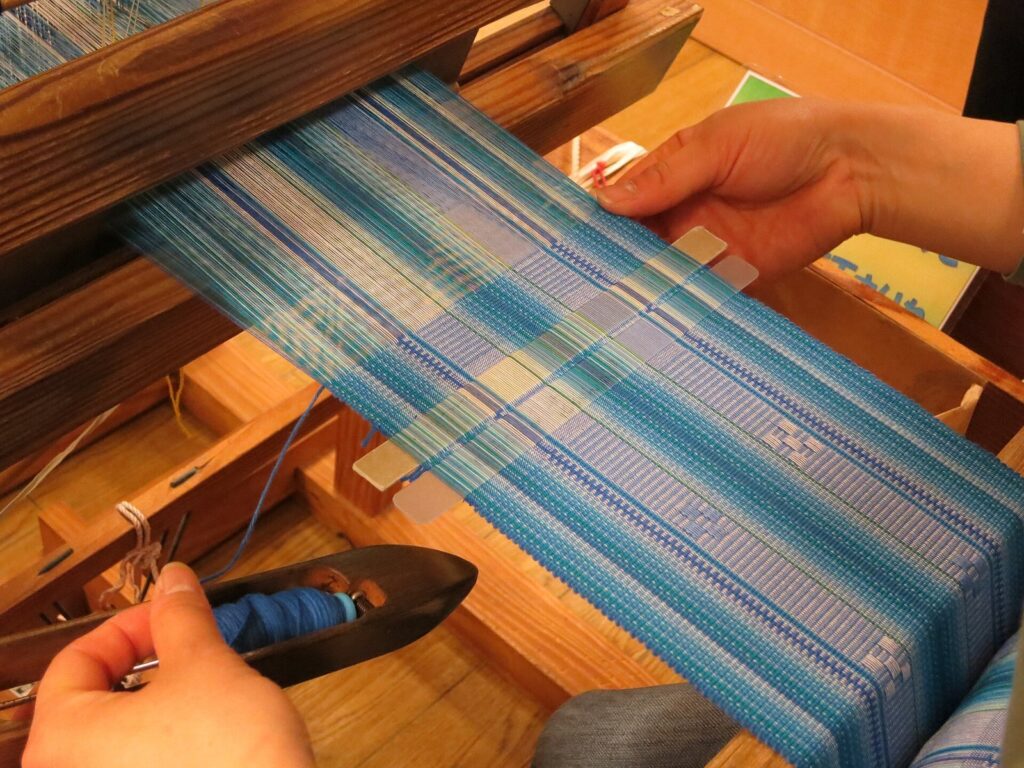
The Ishigaki City Traditional Crafts Hall (石垣市伝統工芸館) has a permanent display on Yaeyama minsā and jōfu, a 25-minute video and a working area where you can watch the craft being done. The Ishigaki City Textile Business Cooperative has its office here.
- Address: 783-2 Tonoshiro, Ishigaki City (石垣市字登野城783-2). Phone: 0980-82-5200.
- Hours: 9:00–17:00; Saturdays 9:00–12:00. Closed on Sundays and public holidays. Admission is free.
- Getting there: about 20–25 minutes by car from New Ishigaki Airport, or a 4-minute walk from the Minsā Kōgeikan-mae (ミンサー工芸館前) bus stop.
Private makers also sell minsā on Ishigaki, including Azamiya’s Minsā Kōgeikan. See our Ishigaki guide for more on the island.
Practical details in this section last checked: Oct 2026.
How to Tell Authentic Yaeyama Minsā
The five-and-four pattern is printed on all kinds of souvenirs, so it is not proof of hand-weaving on its own. Genuine Yaeyama minsā is woven in Ishigaki or Taketomi. Because it is a national Traditional Craft, products that pass inspection can carry the Traditional Craft label. If you want a hand-woven piece, buy from a cooperative, the crafts hall or a known maker, and ask to see the labels.
For the ramie cloth of the same islands, see Yaeyama jōfu; for Yomitan’s very different belt, see Yomitanzan minsā.
Frequently Asked Questions
What is Yaeyama minsā?
Yaeyama minsā is a narrow cotton kasuri belt from Ishigaki and Taketomi, woven in a warp-ribbed weave. It is a national Traditional Craft, designated in 1989 together with Yaeyama jōfu.
What does the five-and-four pattern mean?
The maker Azamiya says the five and four squares carry the wish “for ever and always” (itsu no yo made mo), a play on the Japanese words for five and four.
Can I see minsā woven on Taketomi Island?
The Taketomi Town Textile Business Cooperative is based on the island, about 15 minutes by ferry from Ishigaki. Visitor hours are not published, so contact it first.
Where can I buy Yaeyama minsā on Ishigaki?
At makers such as Azamiya’s Minsā Kōgeikan, and you can learn about it at the free Ishigaki City Traditional Crafts Hall in Tonoshiro.
Is every minsā-patterned souvenir hand-woven?
No. The pattern is widely printed. For hand-woven minsā, buy from the cooperatives or known makers and look for the Traditional Craft label.
Sources & Further Reading
Facts on this page were checked against these sources. Most are official Japanese-language pages from the prefecture, the Agency for Cultural Affairs, producers’ cooperatives and museums.
Official and cooperative sources
- Okinawa Kōgei no Mori: Yaeyama Jōfu and Yaeyama Minsā (prefectural craft centre, Japanese)
- Okinawa Kōgei no Mori: Taketomi Town production area (prefectural craft centre, Japanese)
- Okinawa Kōgei no Mori: Taketomi Town Textile Business Cooperative (history, access) (prefectural craft centre, Japanese)
- Okinawa Kōgei no Mori: Ishigaki City Textile Business Cooperative (prefectural craft centre, Japanese)
- Ishigaki City: Related facilities (Traditional Crafts Hall) (official, Japanese)
- Okinawa Prefecture: Overview of craft industry policy, FY2024 (production-area profiles) (official, Japanese)
- Taketomi Town Chamber of Commerce: Festivals and cultural properties (minsā) (Japanese)
Makers
Image credits
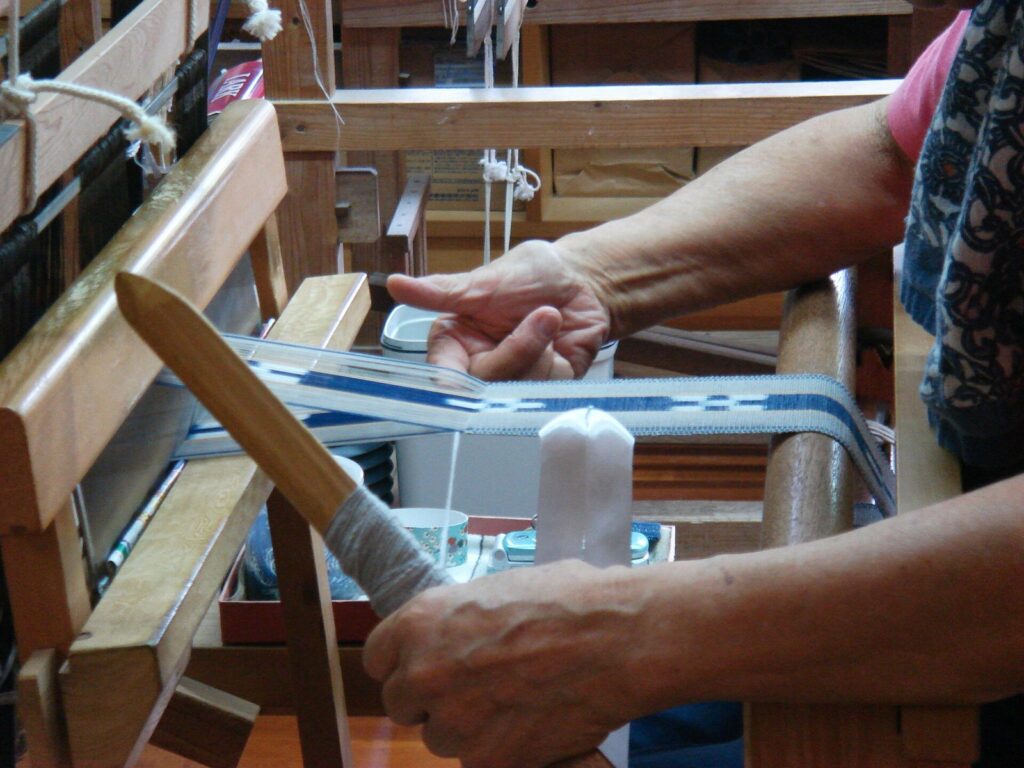
- Weaving a minsā belt on Taketomi Island, 2008. Photo: Ken FUNAKOSHI, CC BY-SA 2.0, via Wikimedia Commons.
- Weaving minsā on Ishigaki. Photo: norio nakayama, CC BY-SA 2.0, via Wikimedia Commons.