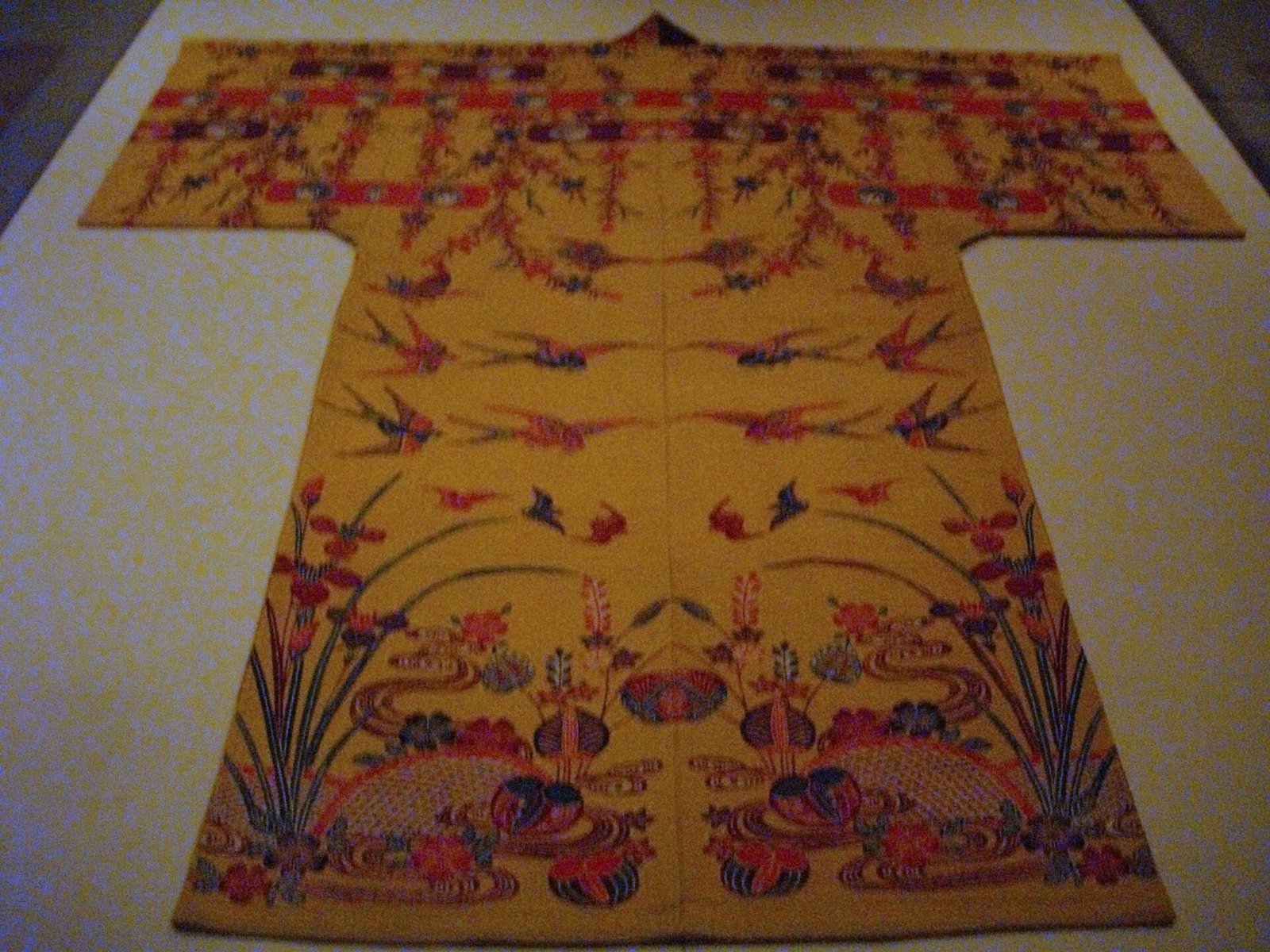
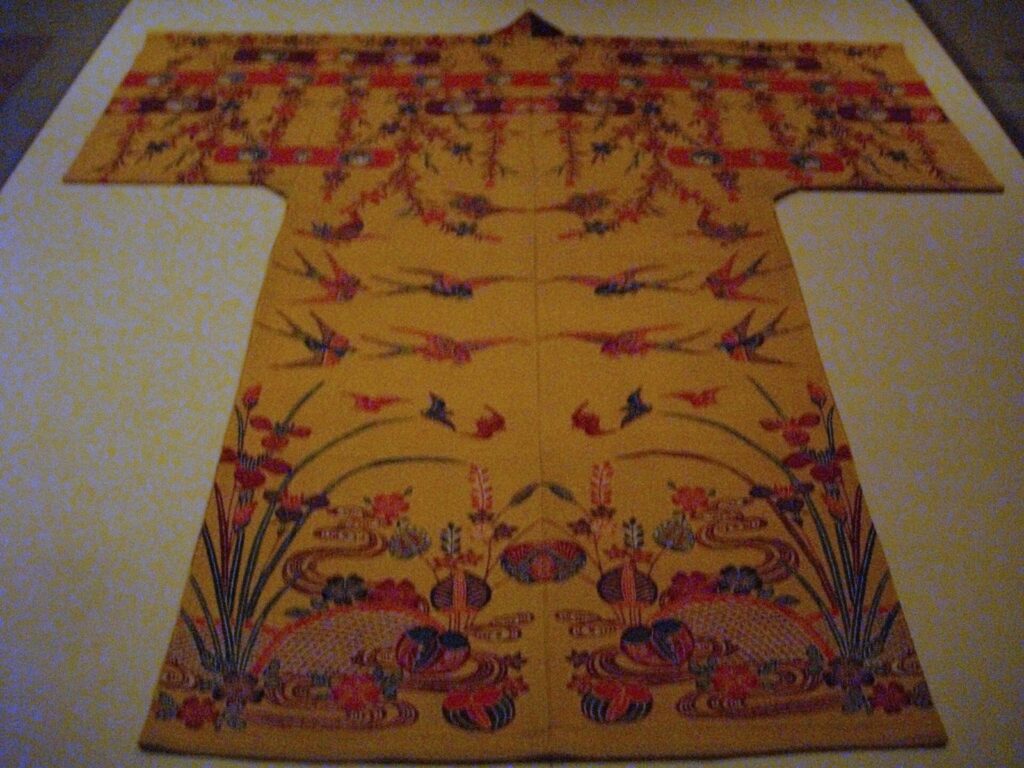
Ryukyu bingata (琉球びんがた, also written 紅型) is Okinawa’s traditional dyed cloth: bright stencil-dyed designs of flowers, birds, water and clouds, coloured by hand with pigments and plant dyes. It is the only dyed textile among Okinawa’s nationally designated crafts, and the prefecture ranks it alongside Kyoto’s Yūzen and Tokyo’s Edo Komon as one of Japan’s great dyeing traditions. You can see historic pieces in museums, watch artisans at work in Shuri, and even dye a bag yourself.
This page is part of our guide to Ryukyuan textiles, which compares all of Okinawa’s woven and dyed crafts.
Bingata at a Glance
| Japanese | 琉球びんがた / 紅型 (bingata); indigo version 藍型 (aigata, Okinawan eegata) |
| What it is | Resist-dyed cloth: rice-paste resist applied through a stencil or from a cone, then colours brushed in by hand |
| Cloth used | Cotton, silk, ramie and bashōfu (banana-fibre cloth) |
| Made in | Naha, Ginowan, Urasoe, Itoman, Tomigusuku and Nanjō |
| Designations | Okinawa Prefecture traditional craft product (1974); national Traditional Craft (伝統的工芸品), Ministry of Economy, Trade and Industry (1984); Important Intangible Cultural Property Bingata, holder Tamanaha Yūkō (1996) |
| Cooperative | Ryukyu Bingata Business Cooperative (琉球びんがた事業協同組合), founded 1976 |
What Does “Bingata” Mean?
The cooperative explains one common reading of the word: bin means colour and gata means pattern. Today the word is used for all of Okinawa’s traditional dyed cloth. It splits into two families: bingata proper, coloured with reds, yellows, blues and greens, and aigata (藍型), dyed in shades of indigo, sometimes with ink. Aigata was often used for summer clothing and is still popular for summer wear.
History
Born from the age of trade
Nobody knows exactly when bingata began. The prefecture says it was probably created before the 15th century, drawing on dyed cloth that reached the islands from China, Japan and elsewhere. The cooperative dates its origin to the 14th–15th centuries, when the Ryukyu Kingdom traded widely, and notes that some place it as early as the 13th century. Indian and Javanese chintz and Chinese stencil-printed cloth are named among its influences.
Under the protection of the royal government, bingata became formal wear for women and costume for religious rites. Court painters and stencil carvers shared the work of designs and stencils. It was worn mostly by women of the royal family and the aristocracy, and boys of the samurai class wore it to perform kumi odori, the classical court dance-drama.
Satsuma, Japan and the classic style
Stencils wear out after two or three years of hard use, so old ones were carefully kept as models for new ones. Many were burned or carried off when the Satsuma domain invaded in the early 17th century. Bingata did not decline, though. The cooperative says the style we know today took shape by around the 18th century, with clear influence from Japanese dyeing that arrived through contact with the Tokugawa shogunate.
Decline and postwar revival
When the kingdom was abolished in 1879, bingata lost its patrons and nearly died out. The Battle of Okinawa then destroyed what was left in Naha. After the war, Shiroma Eiki (城間栄喜) and Chinen Sekikō (知念績弘), heirs of two of the three historic bingata families, returned to the ruined city and started again with whatever they could find.
A preservation society was formed in 1950. In 1973 the prefecture designated bingata an Intangible Cultural Property, and the business cooperative followed in 1976. The national Traditional Craft designation came on 31 May 1984.
Did you know? The postwar revival ran on scrap. According to the bingata cooperative, Shiroma and Chinen cut stencils from discarded military maps, used broken gramophone records as paste spatulas, bullet casings as nozzles for the paste cone, and lipstick as pigment.
How Bingata Is Made
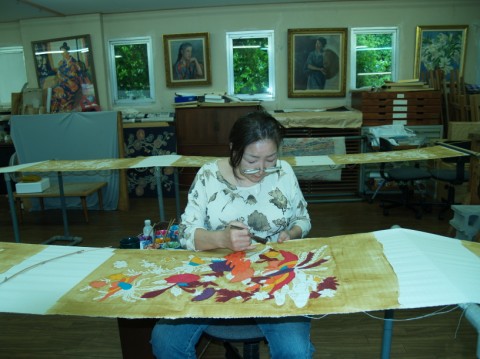
Bingata is a resist-dyeing technique. Paste made from rice is applied to the cloth wherever the dye should not reach, colour is brushed into the open areas, and the paste is washed away at the end. There are two ways to apply the paste:
- Stencil dyeing (型附, katachiki): a hand-cut paper stencil is laid on the cloth and paste is spread through it. The stencil is lifted and the pattern areas are coloured, sometimes followed by dyeing the background. The cooperative lists several styles, including white-ground bingata (白地紅型), coloured-ground bingata (染地紅型), kaeshigata, uburugata (朧型) and techiki (手附). This is mostly used for clothing.
- Freehand paste drawing (筒描き, tsutsugaki; in Okinawa 糊引, nuibichi): paste is squeezed from a cone-shaped bag to draw the design by hand. It is technically demanding and is used mainly for wrapping cloths (furoshiki) and large stage curtains, so auspicious motifs are common.
Colours are built up in layers. A characteristic touch is kumadori (隈取), a second, darker colour brushed into part of a motif to give soft shading. The Agency for Cultural Affairs also notes the traditional rukujū (ルクジュウ), a block of dried tofu used as a backing board when cutting stencils.
Unusually for a Japanese craft, bingata is not divided among specialists. The cooperative stresses that each artisan carries out the whole process, down to making their own tools. That is slow, but it is part of the tradition.
Motifs and Colours
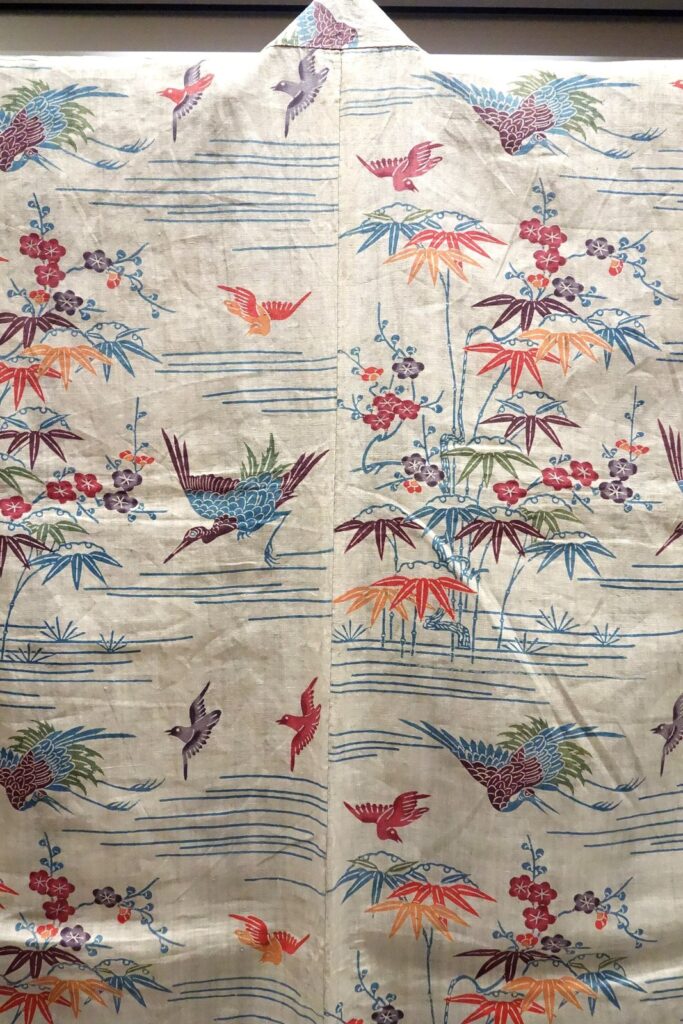
Bingata is famous for vivid colours, bold colour combinations and simple, clear shapes. Typical motifs include flowers, birds, flowing water, waves, clouds and pine. The cooperative stresses that bingata does not simply mirror Okinawa’s natural surroundings: shaped by centuries of trade, it combines fine detail with bold simplification, and Chinese splendour with Japanese elegance.
Living National Treasure and Other Recognition
Tamanaha Yūkō (玉那覇有公) was certified as the holder of the Important Intangible Cultural Property Bingata (紅型) on 10 May 1996. He is still listed as the holder in the Agency for Cultural Affairs database and in the prefecture’s June 2024 list. Holders are popularly called Living National Treasures.
At prefectural level, bingata (びん型) has been an Intangible Cultural Property since 1973, with its holders organised as the Okinawa Traditional Bingata Preservation Society (沖縄伝統びん型保存会). The cooperative also registered Ryukyu Bingata as a regional collective trademark.
Where to See, Try and Buy Bingata
Shuri Senshokukan suikara (Naha)
The best single stop is Shuri Senshokukan suikara (首里染織館suikara), a centre for Shuri textiles and bingata that opened in 2022 near Shuri Castle. The bingata cooperative’s workshop is on the second floor. In its regular experience, you brush colour onto a tote bag that already has the resist paste applied, take it home, and wash out the paste yourself after a few days once the colour has set. Booking is recommended, though you can join on the day if there is space. A four-day course to dye a bingata shawl is available by advance booking.
suikara opens 10:30–18:00 and is closed on Tuesdays, over the New Year and on Ukui, the last day of the lunar Obon holiday. It is about a seven-minute walk from Shuri Station on the Yui Rail monorail. Phone: 098-917-6030.
Naha City Traditional Arts and Crafts Center
On the second floor of Tenbusu Naha on Kokusai Street, the Naha City Traditional Arts and Crafts Center (那覇市伝統工芸館) displays and sells work by Naha artisans and offers bookable bingata experiences. It is about a five-minute walk from Makishi Station.
Seeing historic bingata
Historic bingata is shown in rotating displays at the Okinawa Prefectural Museum & Art Museum in Naha and in museums abroad, including the Tokyo National Museum. Bingata costumes are also worn by performers of classical Ryukyuan dance; see our music and performing arts guide.
Practical details in this section last checked: Oct 2026.
How to Tell Authentic Ryukyu Bingata
Printed “bingata-style” fabric is everywhere in Okinawa’s souvenir shops. Genuine hand-dyed pieces made under the cooperative’s rules carry labels:
- Okinawa Prefecture bingata inspection label (沖縄県紅型検査済之証): attached to pieces that pass the prefecture’s bingata inspection standard, each managed by a label number.
- Cooperative label (琉球びんがた事業協同組合之証): on work by cooperative members. It shows the regional trademark registration number (No. 5010729), and the maker’s name is always written by hand, never stamped. Work by non-members carries only the prefectural label.
- Traditional Craft label (伝統証紙): the national sticker for inspected products of designated Traditional Crafts.
Hand-dyed bingata is expensive. If a bingata-patterned item is very cheap and has none of these labels, it is almost certainly printed. Printed designs are fine as souvenirs, but they are not bingata.
Frequently Asked Questions
What is bingata?
Bingata is Okinawa’s traditional resist-dyed cloth. Rice paste is applied through a stencil or from a cone, colours are brushed on by hand, and the paste is washed out. It is the only dyed textile among Okinawa’s nationally designated crafts.
What is the difference between bingata and aigata?
Bingata uses many colours, such as red, yellow and blue. Aigata (藍型) is the same family of dyeing done in shades of indigo, sometimes with ink, and was often used for summer clothing.
Where can I try bingata dyeing in Okinawa?
Shuri Senshokukan suikara in Shuri, Naha, offers a bingata tote-bag experience in the cooperative’s workshop, and the Naha City Traditional Arts and Crafts Center at Tenbusu Naha offers bookable bingata experiences. Booking ahead is recommended.
How can I tell if bingata is genuine?
Look for the Okinawa Prefecture bingata inspection label and, for cooperative members’ work, the Ryukyu Bingata cooperative label with trademark number 5010729 and a handwritten maker’s name. Designated products may also carry the national Traditional Craft label.
Is there a Living National Treasure for bingata?
Yes. Tamanaha Yūkō was certified as holder of the Important Intangible Cultural Property Bingata in 1996 and is still listed as holder by the Agency for Cultural Affairs.
Sources & Further Reading
Facts on this page were checked against these sources. Most are official Japanese-language pages from the prefecture, the Agency for Cultural Affairs, producers’ cooperatives and museums.
Official and cooperative sources
- Okinawa Kōgei no Mori: Ryukyu Bingata (prefectural craft centre, Japanese)
- Ryukyu Bingata Business Cooperative: What is Ryukyu bingata? (Japanese)
- Ryukyu Bingata Business Cooperative: History of Ryukyu bingata (Japanese)
- Ryukyu Bingata Business Cooperative: Quality labels (Japanese)
- Okinawa Prefecture: Overview of craft industry policy, FY2024 (production-area profiles and holder lists as of June 2024) (official, Japanese)
- Agency for Cultural Affairs, Database of National Cultural Properties: Bingata (紅型) (official, Japanese)
- Okinawa Prefecture: list of designated cultural properties and holders (2021) (PDF, Japanese)
Places to visit
- Shuri Senshokukan suikara: experience programmes, hours and closing days (Japanese)
- Naha City Traditional Arts and Crafts Center (Japanese)
Further reading
- The George Washington University Museum and The Textile Museum: Bingata! Only in Okinawa (English)
- Kodama Eriko, Ryūkyū Bingata (琉球紅型), ADP, 2012 (book, Japanese)
Image credits
- A yellow bingata robe with birds, hanging branches and flowing water, on display. Photo: LordAmeth, CC BY-SA 2.0, via Wikimedia Commons.
- An artisan brushing colour onto a patterned cloth at a dyeing workshop. Photo: okinawa.com.
- Bingata dress with bamboo, crane and plum on a white ground, Okinawa Main Island, 19th century. Tokyo National Museum. Photo: Daderot, public domain, via Wikimedia Commons.