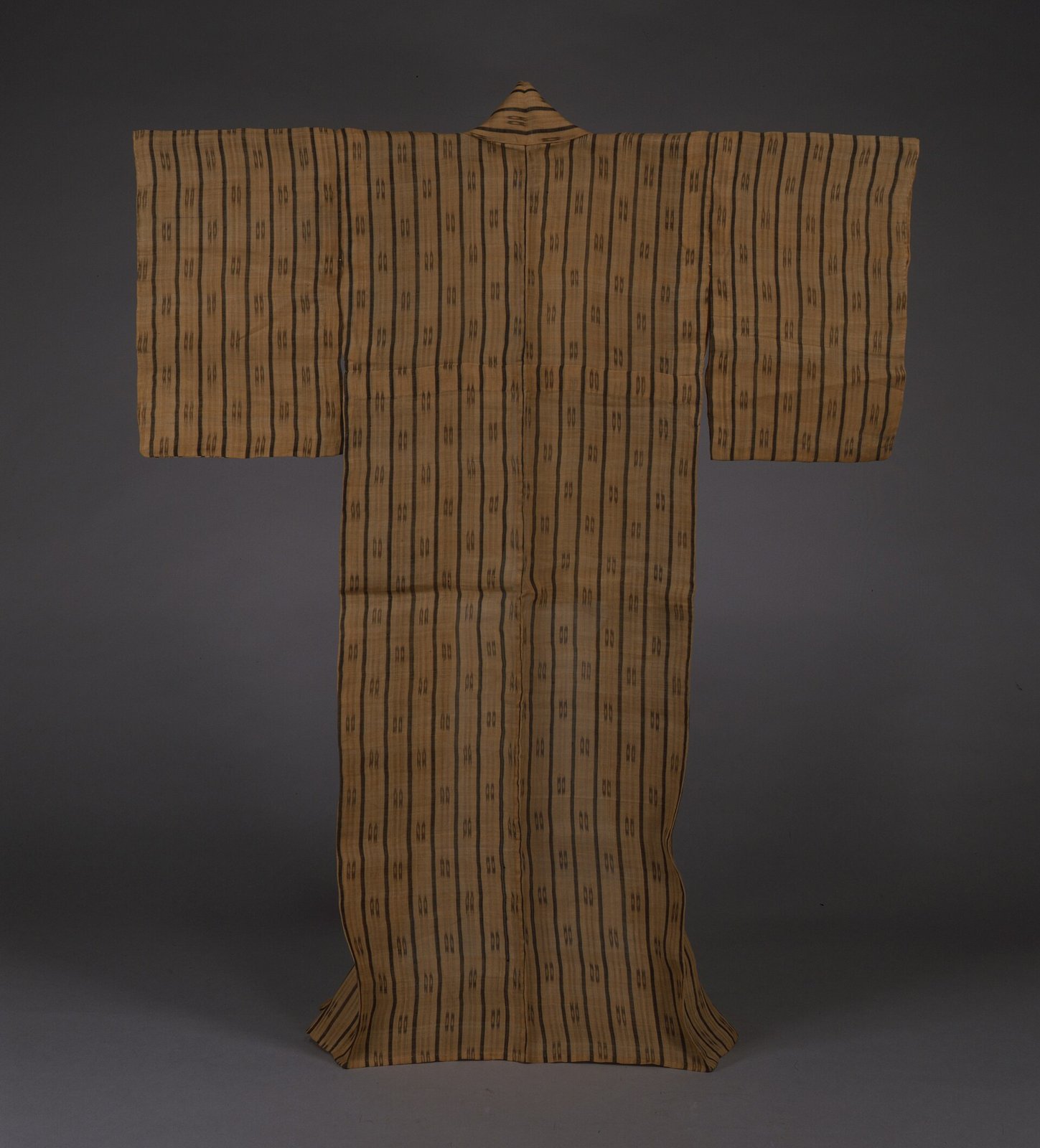
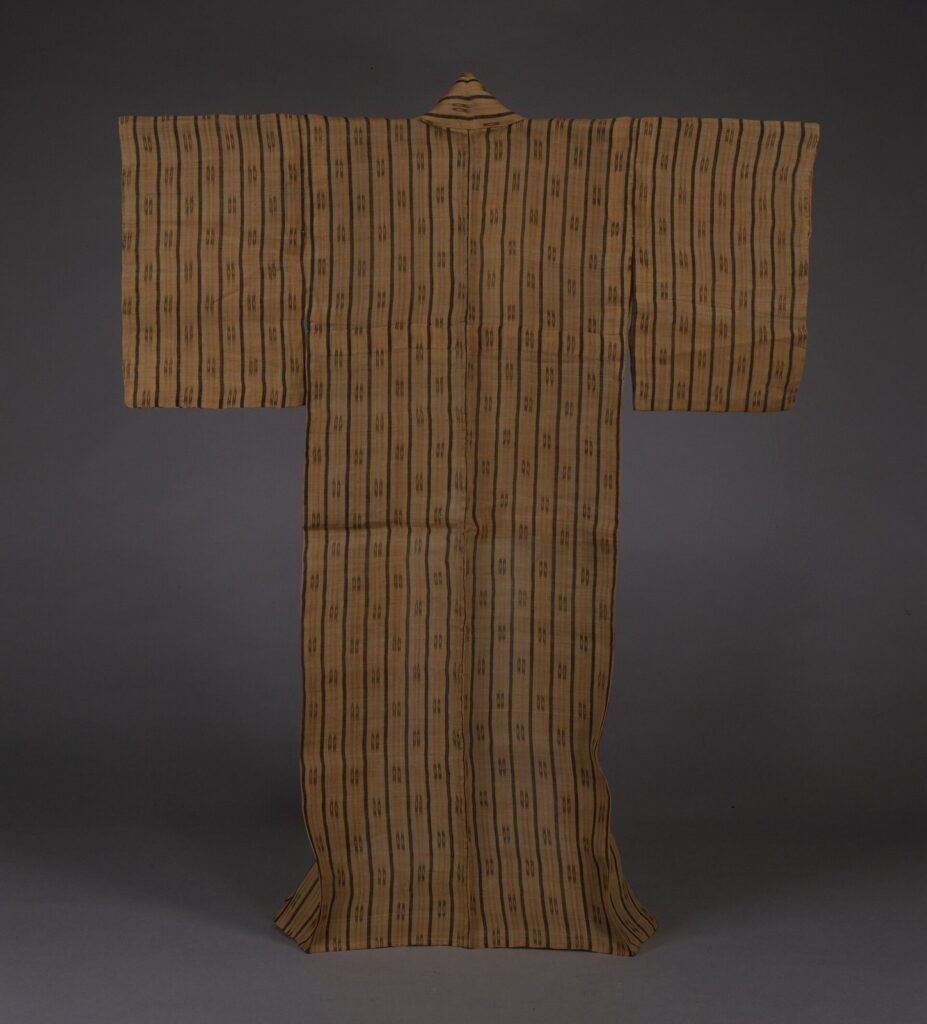
Kijoka bashōfu (喜如嘉の芭蕉布) is cloth woven from the fibre of the thread-banana plant in the village of Kijoka, in Ōgimi in the far north of Okinawa’s Main Island. It is light and crisp and stands slightly away from the skin, which made it Okinawa’s everyday summer cloth for centuries. Kijoka is now the only place where bashōfu is made on a regular basis. Every stage, from growing the plants to the final wash, is still done by hand, and you can watch the work at the village’s Bashōfu Hall.
This page is part of our guide to Ryukyuan textiles, which compares all of Okinawa’s woven and dyed crafts.
Bashōfu at a Glance
| Japanese | 喜如嘉の芭蕉布 (Kijoka no bashōfu); the plant and its fibre are called ū (苧) locally |
| Fibre | Itobashō (糸芭蕉), the thread banana, a relative of the fruiting banana |
| Dyes | Mainly sōshiju (Taiwan acacia) and Ryukyu indigo |
| Made in | Kijoka, Ōgimi Village (a little is also made in Nakijin) |
| Designations | Important Intangible Cultural Property, holding group Kijoka Bashōfu Preservation Society (1974); prefectural traditional craft product (1974); national Traditional Craft, Ministry of Economy, Trade and Industry (1988) |
| Visit | Ōgimi Village Bashōfu Hall (大宜味村立芭蕉布会館) |
A Cloth for Kings and Commoners
Nobody knows exactly when bashōfu began. Old documents suggest it was being woven by the 12th–13th centuries, and by the 16th century thread was being made in much the same way as today. In 1648 the royal government created an office, the bashō tōshoku (芭蕉当職), to promote production. Records from the 16th–17th centuries show bashōfu sent as gifts to China and Korea and as tribute to the Shimazu lords of Satsuma.
Bashōfu was worn by everyone. Royalty and the aristocracy used it for official dress, while for ordinary people across the Ryukyu Islands it was an essential cloth in the hot, humid climate. Until the Second World War it was woven all over Okinawa. The Agency for Cultural Affairs notes that kasuri (ikat) patterns were adopted in Kijoka during the Meiji era.
Taira Toshiko and the revival
After the war, bashōfu was close to disappearing. Its revival as a fine craft is the work of Taira Toshiko (平良敏子) of Kijoka. In 1944 she joined a women’s volunteer labour corps sent to work at a Kurashiki spinning mill on the mainland that had been turned over to aircraft production. The company president, Ōhara Sōichirō, was a keen supporter of the mingei folk-craft movement and gave the young women a chance to study weaving after the war ended.
Back in Kijoka, Taira and the women of the village rebuilt production. A Kijoka bashōfu union was set up in 1955 and training courses followed, and a business cooperative was formed in the 1980s. The village-owned Bashōfu Hall opened in 1985 as the centre of production. Taira was certified individually as a holder of the Important Intangible Cultural Property Bashōfu in 2000, the honour popularly called a Living National Treasure. She died in 2022, aged 101.
Did you know? Weaving is only about 1% of the work. The Kijoka preservation society counts 23 separate stages in making bashōfu, and by the prefecture’s figures a single bolt uses the fibre of about 200 plants.
From Banana Plant to Cloth
The Kijoka society describes 23 stages. In outline:
- Growing: wild thread banana has stiff fibre, so Kijoka cultivates its own. Leaves and growing tips are cut back several times a year to keep the fibre soft.
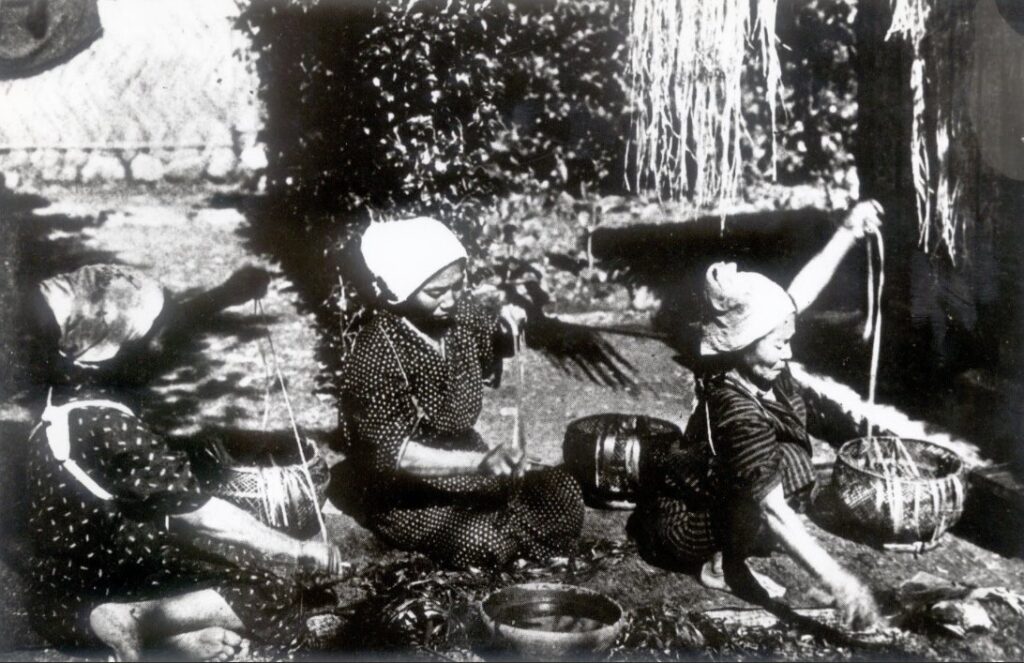
- Stripping: the cut stem is made of more than 20 layers. These are peeled off one by one and sorted into four grades; the softest come from the centre.
- Boiling and cleaning: the bark is boiled in wood-ash lye, rinsed, and scraped with bamboo tongs called ēbi to remove impurities. Soft fibre is set aside for weft, harder or coloured fibre for warp.
- Making thread (苧績み, ū-umi): the fibre is split to the right thickness with a small knife and knotted end to end with a tiny weaver’s knot. This is the step that takes the most experience.
- Twisting, warping and boiling the skeins to strengthen and soften the thread.
- Kasuri tying and dyeing: sections of thread are bound with banana bark and plastic tape, then dyed, mainly with sōshiju and Ryukyu indigo.
- Setting up the loom and weaving: banana thread breaks easily when dry, so weavers mist it constantly as they work on a high loom.
- Washing: about a dozen finishing steps, including boiling in lye and soaking in a neutralising bath called yunaji, before the cloth is straightened.
Sources differ on how long a bolt takes. The prefecture’s craft overview gives about two months, while the prefectural craft centre’s database says about six months. Either way, it is slow work, and the prefecture warns that hand-spun banana thread is in short supply because the people who make it are ageing.
Patterns
Kijoka bashōfu is known for fresh, simple kasuri patterns set among stripes, like the small yotsume crosses on the kimono shown at the top of this page. The folk-craft writer Yanagi Sōetsu praised it highly in his essay Bashōfu Monogatari, which the society quotes: such beautiful cloth, he wrote, is rarely found today.
Living National Treasure and Preservation Society
Kijoka no Bashōfu was designated an Important Intangible Cultural Property on 20 April 1974, with the Kijoka Bashōfu Preservation Society (喜如嘉の芭蕉布保存会) recognised as the holding group. According to the prefecture’s June 2024 list, the society’s representative is Taira Mieko (平良美恵子). The separate individual designation for Bashōfu was lifted after Taira Toshiko’s death in 2022, so as of that list there is no individual holder.
Visiting the Bashōfu Hall in Kijoka
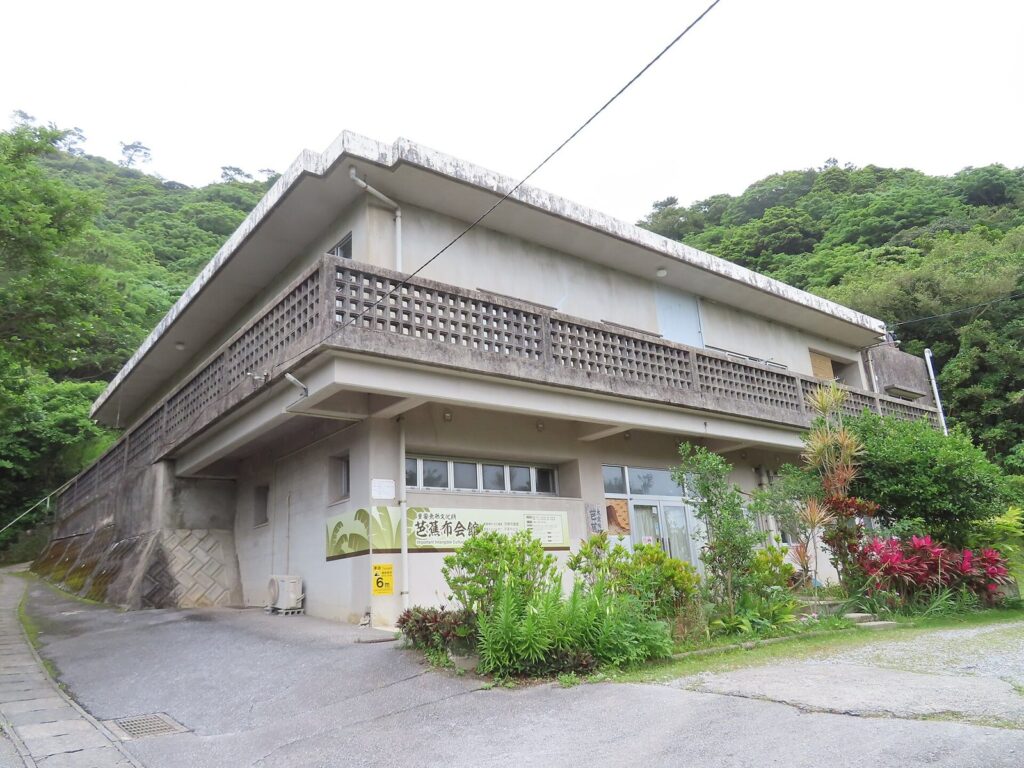
The Ōgimi Village Bashōfu Hall (大宜味村立芭蕉布会館) is run by the Kijoka bashōfu cooperative. You can watch the production work there; the upstairs workshop may be closed to visitors at certain stages of the process.
- Address: 454 Kijoka, Ōgimi Village (大宜味村字喜如嘉454)
- Hours: 10:00–17:00. No viewing during the lunch break, 12:00–13:00.
- Closed: Sundays, the lunar Obon holiday, New Year and occasional other days. Call ahead: 0980-44-3033.
Please be considerate: the preservation society asks visitors not to interrupt the artisans’ concentration. Filming and media visits need an advance booking, and private workshops in the village cannot be visited.
Combine a visit with the forests and waterfalls of Northern Okinawa; our getting around guide explains your transport options.
Buying bashōfu
The Bashōfu Hall does not sell bolts of kimono cloth. Small items made from Kijoka bashōfu are sold at the hall, at the Yuimui museum shop of the Okinawa Prefectural Museum & Art Museum in Naha, and through the society’s official online shop.
Practical details in this section last checked: Oct 2026.
Frequently Asked Questions
What is bashōfu made from?
Bashōfu is woven from the fibre of the thread banana (itobashō), a relative of the fruiting banana. In Kijoka the plants are grown, stripped, boiled and split into thread by hand.
Where can I see bashōfu being made?
At the Ōgimi Village Bashōfu Hall in Kijoka, northern Okinawa, open 10:00–17:00 and closed on Sundays, Obon and New Year. There is no viewing from 12:00 to 13:00.
Can I buy a bashōfu kimono at the Bashōfu Hall?
No. The hall does not sell bolts. It sells small items made from Kijoka bashōfu, which are also available at the prefectural museum shop in Naha and from the official online shop.
How long does it take to make bashōfu?
Sources differ: the prefecture gives about two months per bolt, while the prefectural craft centre says about six months. One bolt uses the fibre of about 200 plants.
Who was Taira Toshiko?
Taira Toshiko (1921–2022) led the postwar revival of bashōfu in Kijoka. She was certified as a holder of the Important Intangible Cultural Property Bashōfu, a Living National Treasure, in 2000.
Sources & Further Reading
Facts on this page were checked against these sources. Most are official Japanese-language pages from the prefecture, the Agency for Cultural Affairs, producers’ cooperatives and museums.
Official and producer sources
- Kijoka no Bashōfu (official site of the preservation society): About bashōfu (Japanese)
- Kijoka no Bashōfu: the 23 stages of production (Japanese)
- Kijoka no Bashōfu: FAQ (visiting, opening hours, buying) (Japanese)
- Kijoka no Bashōfu: Kijoka Bashōfu Preservation Society (Japanese)
- Okinawa Kōgei no Mori: Kijoka no Bashōfu (prefectural craft centre, Japanese)
- Okinawa Prefecture: Overview of craft industry policy, FY2024 (production-area profiles and holder lists as of June 2024) (official, Japanese)
- Agency for Cultural Affairs, Database of National Cultural Properties: Kijoka no Bashōfu (official, Japanese)
- National Crafts Museum (MOMAT): exhibition on Taira Toshiko and Kijoka bashōfu (Japanese)
Further reading
- Katrien Hendrickx, The Origins of Banana-fibre Cloth in the Ryukyus, Japan, Leuven University Press, 2007 (book, English)
- Yanagi Sōetsu, Bashōfu Monogatari (芭蕉布物語) (essay, Japanese)
Image credits
- A bashōfu kimono with stripes and yotsume kasuri. Tokyo National Museum. Photo: National Institutes for Cultural Heritage (ColBase), CC BY 4.0, via Wikimedia Commons.
- Women preparing bashō fibre in Okinawa, before 1946. Photo: pre-war photographer, via Naha City Museum of History archive, public domain, via Wikimedia Commons.
- The Bashōfu Hall in Kijoka, Ōgimi. Photo: 運動会プロテインパワー, CC BY-SA 4.0, via Wikimedia Commons.