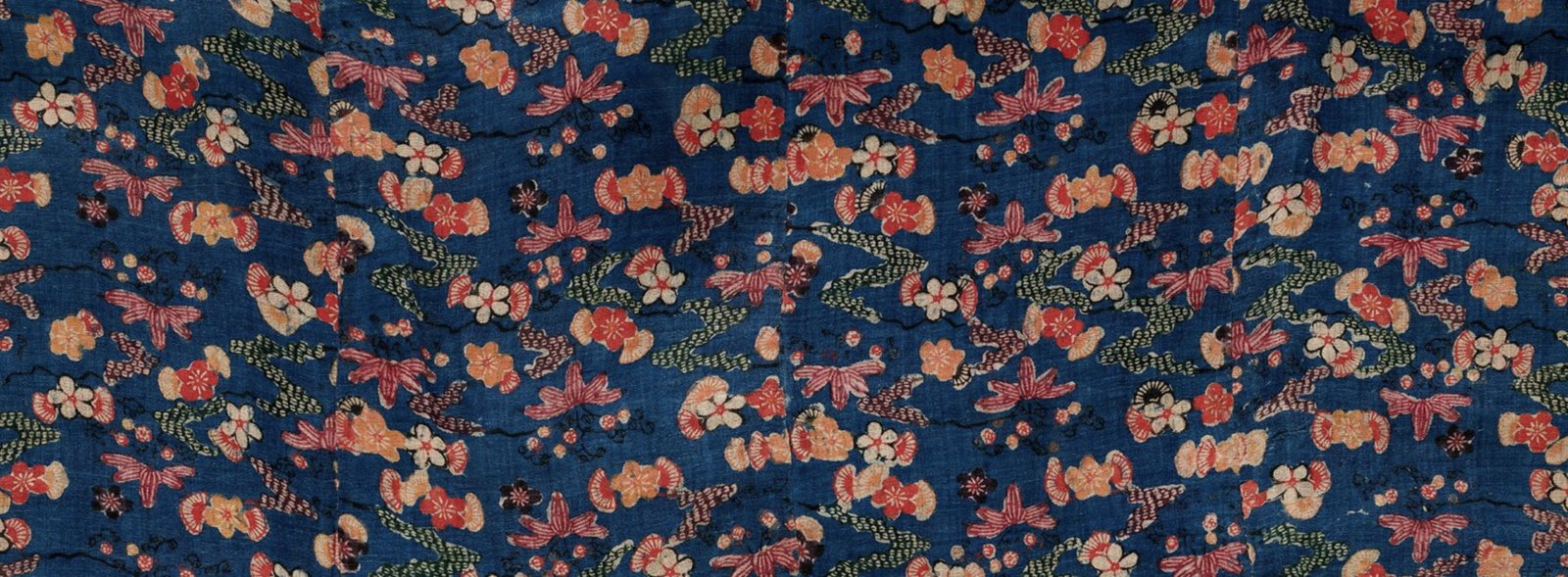
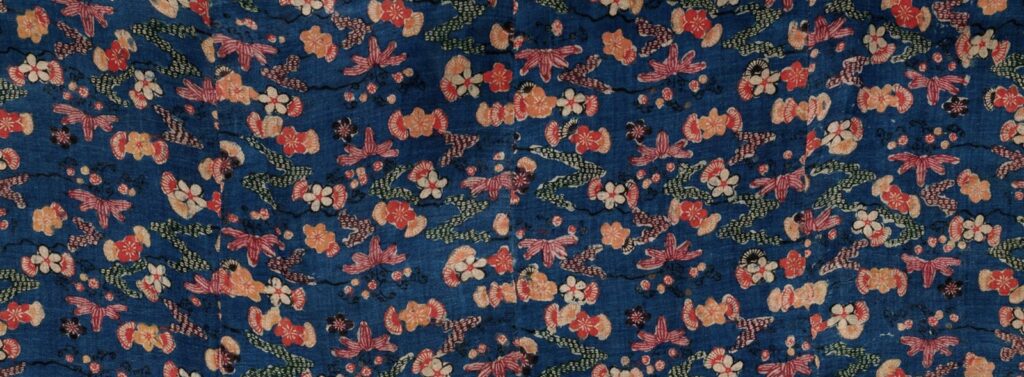
Okinawa’s islands have woven and dyed cloth for centuries, and few places in Japan pack so many distinct traditions into such a small area. Under the Ryukyu Kingdom, fine cloth was paid as tax, presented as tribute and worn to show rank. Each island developed its own fibres, colours and patterns, from the bright stencil-dyed bingata of Shuri to the airy banana-fibre bashōfu of the northern village of Kijoka.
This guide introduces Ryukyuan textiles for visitors: the officially recognised crafts, the stories behind them, and where you can see weavers at work, try a loom yourself and buy a genuine piece to take home. For more on the islands’ heritage, see our Culture & History section.
A Short History of Okinawan Cloth
Weaving in the Ryukyus is old. Korean castaways who drifted to Yonaguni, Japan’s westernmost island, in the 1470s described islanders weaving cloth, in an account recorded in the Korean annals in 1479. By the early 16th century Yonaguni was sending woven cloth to the Ryukyu court. As the kingdom traded with China, Southeast Asia and Japan, its weavers absorbed new techniques, especially kasuri (ikat, in which threads are tie-dyed before weaving) and float-woven patterns.
After Satsuma’s invasion in 1609, cloth became a heavy burden. On Miyako and Yaeyama a head tax, in force until 1903, required women to weave fine ramie cloth for the authorities.
The Battle of Okinawa in 1945 destroyed workshops, looms and pattern records, and several traditions came close to disappearing. Their revival in the decades that followed, led largely by women weavers, is one of the great stories of postwar Okinawa. You can read more about the war years in our guide to the Battle of Okinawa.
Okinawa’s Officially Designated Textiles
Japan’s Ministry of Economy, Trade and Industry (METI) designates Traditional Crafts (伝統的工芸品) that meet strict criteria for history, handwork and local production. Okinawa Prefecture has 16 designated crafts, and 13 of them are textiles: 12 woven and one dyed. The other three are Tsuboya pottery, Ryukyu lacquerware and the sanshin.
| Craft | Japanese | Where | In brief |
|---|---|---|---|
| Kumejima Tsumugi | 久米島紬 | Kumejima | Silk pongee in deep browns and blacks, dyed with island plants and mud, with hand-tied kasuri patterns. Designated 1975. |
| Miyako Jōfu | 宮古上布 | Miyakojima, Tarama | Very fine hand-spun ramie with tiny indigo kasuri, beaten with a mallet to give a glossy finish. Designated 1975. |
| Yomitanzan Hanaori | 読谷山花織 | Yomitan | Small geometric “flower” motifs raised in floats of coloured thread. Designated 1976. |
| Yomitanzan Minsā | 読谷山ミンサー | Yomitan | Narrow cotton belts with float-woven patterns. Designated 1976. |
| Ryukyu Kasuri | 琉球絣 | Naha, Yaese, Haebaru | Ikat cloth, now mostly silk, drawing on a large stock of traditional motifs. Designated 1983. |
| Shuri Ori | 首里織 | Naha, Nishihara, Haebaru | The textiles of the royal capital, covering several techniques once reserved for the court and aristocracy. Designated 1983. |
| Yonaguni Ori | 与那国織 | Yonaguni | Four types of cloth from Japan’s westernmost island: hanaori, dutati, shidadi and kagannubū. Designated 1987. |
| Kijoka no Bashōfu | 喜如嘉の芭蕉布 | Ōgimi (Kijoka) | Light, crisp cloth woven from thread-banana fibre. Designated 1988. |
| Yaeyama Minsā | 八重山ミンサー | Ishigaki, Taketomi | Cotton cloth with the famous “five and four” kasuri squares, traditionally a love token. Designated 1989. |
| Yaeyama Jōfu | 八重山上布 | Ishigaki, Taketomi | White ramie with reddish-brown patterns brushed on with kūru (dye yam) and bleached in the sea and sun. Designated 1989. |
| Chibana Hanaori | 知花花織 | Okinawa City | Hanaori known for warp floats running vertically and embroidery-like patterns. Designated 2012. |
| Haebaru Hanaori | 南風原花織 | Haebaru | Varied hanaori techniques, including a double-sided float weave with no loose threads on the back. Designated 2017. |
| Ryukyu Bingata | 琉球びんがた | Naha, Ginowan, Urasoe, Itoman, Tomigusuku | The one dyed textile: vivid stencil resist-dyeing with pigments and plant dyes. Designated 1984. |
Other Ryukyuan Textile Traditions at a Glance
These traditions are not on the national (METI) list of Okinawa’s Traditional Crafts under their own names: one is covered by a broader designation, others have prefectural status or none, one is a dye, and one comes from neighbouring Kagoshima Prefecture.
| Craft | Japanese | Where | In brief |
|---|---|---|---|
| Shuri Hanakura-ori | 首里花倉織 (Shuri hanakura-ori) | Naha (Shuri) | Silk hanaori combined with sheer ro and sha gauze in checks or blocks, once summer wear for queens and princesses. Not listed separately: covered by the national Shuri Ori designation (1983); prefectural traditional craft product (1998); one of the seven techniques of the Important Intangible Cultural Property Shuri no Orimono. |
| Yaeyama Kōfu (Gunbō) | 八重山交布 (Yaeyama kōfu, gunbō) | Ishigaki, Taketomi | Everyday cross-woven cloth with a warp of cotton or silk and a weft of ramie, bashō or silk. Prefectural traditional craft product (1998); not a national Traditional Craft. |
| Tonbyan | 桐板 (tonbyan; tunban in Shuri) | Formerly Okinawa, including Shuri | Sheer, translucent summer cloth of the Ryukyu elite, woven from imported thread until about the 1930s. Fibre uncertain: ramie, banana fibre, agave and pineapple have all been proposed. No longer made; no designation. |
| Ryukyu Indigo (indigo dyeing) | 琉球藍 (Ryūkyū ai) | Motobu (Izumi) | The blue dye of most Okinawan textiles, made from Strobilanthes cusia as a precipitated paste, doro-ai. A dye rather than a cloth: its production is a national Selected Conservation Technique (selected 1977; preservation society recognised 2002). |
| Amami Ōshima Tsumugi | 本場奄美大島紬 (honba Amami Ōshima tsumugi) | Amami Islands, Kagoshima Prefecture | Silk kasuri bound on a shime-bata loom and dyed dark brown with techi-gi and mud. National Traditional Craft as 本場大島紬 (honba Ōshima tsumugi), designated 1975 under Kagoshima and Miyazaki, not Okinawa. The Amami Islands are Ryukyuan islands, ruled by Satsuma from 1609 and part of Kagoshima Prefecture since 1871, apart from US administration in 1946–53. |
Explore Each Textile
Each of these pages gives the history, materials, techniques, holders, where to see or try the craft, and how to spot the genuine article. Seventeen cover Okinawa; Amami Ōshima Tsumugi is a related textile from neighbouring Kagoshima Prefecture.
Ryukyu Bingata
琉球びんがた. Bright stencil-dyed cloth of the Ryukyu court, made in and around Naha.
Kijoka Bashōfu
喜如嘉の芭蕉布. Crisp banana-fibre cloth from Ōgimi, an Important Intangible Cultural Property.
Shuri Ori
首里織. The many royal weaves of Shuri, from kasuri to hanaori and minsā.
Shuri Hanakura-ori
首里花倉織. Airy summer silk once reserved for the royal family.
Ryukyu Kasuri
琉球絣. Okinawa’s ikat weaving, centred on Haebaru.
Haebaru Hanaori
南風原花織. A warm, varied flower weave from southern Okinawa.
Chibana Hanaori
知花花織. Okinawa City’s festival flower weave with warp-float patterns.
Yomitanzan Hanaori
読谷山花織. Yomitan’s colourful flower weave, revived from 1964.
Yomitanzan Minsā
読谷山ミンサー. A narrow cotton belt with hand-picked motifs.
Kumejima Tsumugi
久米島紬. Island silk dyed with plants and mud, finished by mallet.
Miyako Jōfu
宮古上布. Fine hand-spliced ramie dyed deep indigo.
Yaeyama Jōfu
八重山上布. White ramie with kasuri rubbed on in kūru dye.
Yaeyama Minsā
八重山ミンサー. The five-and-four kasuri belt of Ishigaki and Taketomi.
Yaeyama Kōfu (Gunbō)
八重山交布. Yaeyama’s everyday cross-woven cloth.
Yonaguni Ori
与那国織. Four textiles from Japan’s westernmost island.
Ryukyu Indigo
琉球藍. The plant dye behind Okinawa’s blues, made in Motobu.
Tonbyan
桐板. The lost translucent summer cloth of Ryukyu’s elite.
Amami Ōshima Tsumugi (related, Kagoshima)
本場奄美大島紬. Mud-dyed kasuri silk from the Amami Islands of Kagoshima.
Bingata: Okinawa’s Colourful Dyed Cloth
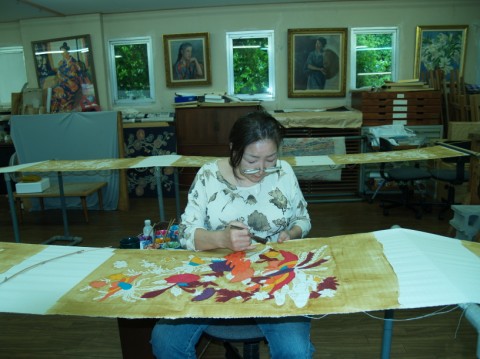
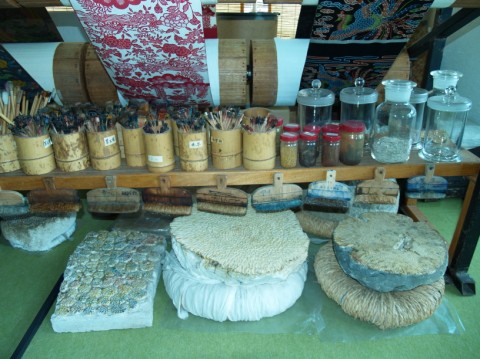
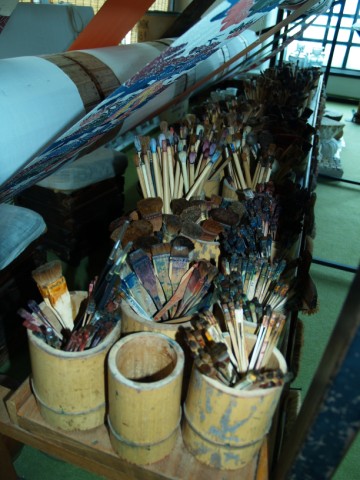
Bingata (紅型, bingata) is the textile most visitors notice first. Artisans cut a stencil, apply rice paste through it to resist the dye, then brush on layer after layer of pigments and plant dyes before washing the paste away. The results are bright yellows, reds and blues with flowers, birds, waves and clouds, a palette unlike anything in mainland Japanese dyeing.
Bingata was historically worn by Ryukyu royalty and aristocrats, and performers of classical Ryukyuan dance still wear it on stage. Our music and performing arts guide explains where to see a performance. Today you will also find bingata on tote bags, coasters and scarves, which make easy souvenirs.
Bashōfu: Banana-Fibre Cloth of Kijoka
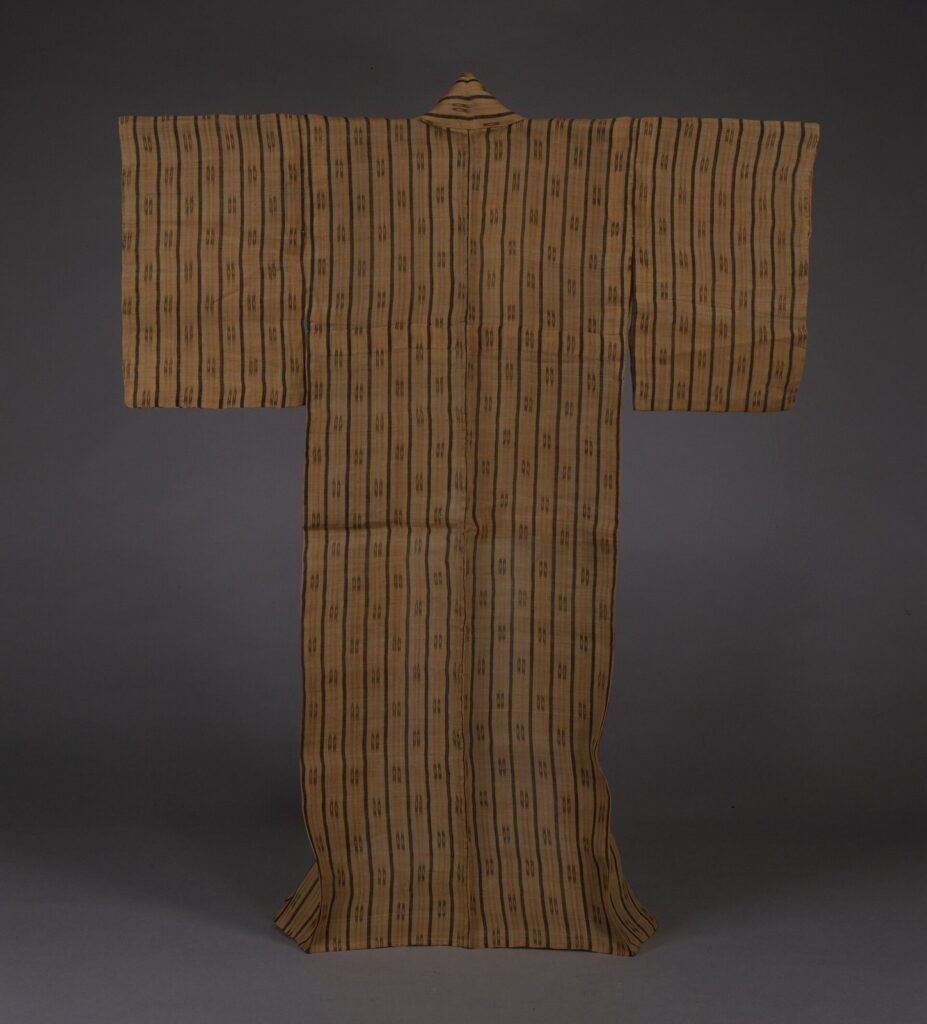
Bashōfu (芭蕉布) is woven from the fibre of the itobashō, or thread-banana plant. Turning a field of banana stalks into cloth takes a long chain of steps: growing the plants, stripping and boiling the fibre, splitting it by hand into fine threads, knotting them end to end, dyeing, weaving and washing. The finished cloth is light and stands slightly away from the skin, which made it the everyday summer wear of Okinawa for centuries.
The village of Kijoka in Ōgimi, in the far north of the Main Island, is the centre of the craft today. Its revival is closely tied to Taira Toshiko (平良敏子, 1921–2022). Returning home in 1946, she found that the banana groves had been cut down, partly over fears they harboured malaria mosquitoes. She replanted them and rebuilt production with the women of the village.
Important Intangible Cultural Property
In 1974, Japan designated Kijoka no Bashōfu an Important Intangible Cultural Property, recognising the Kijoka preservation society as a group, with Taira Toshiko as its representative. In 2000 she was also certified individually as a holder for bashōfu, the title popularly known as a Living National Treasure. She died in 2022 at the age of 101. Other Okinawan textiles have also received this national recognition, including Miyako Jōfu, Kumejima Tsumugi, Shuri textiles and bingata.
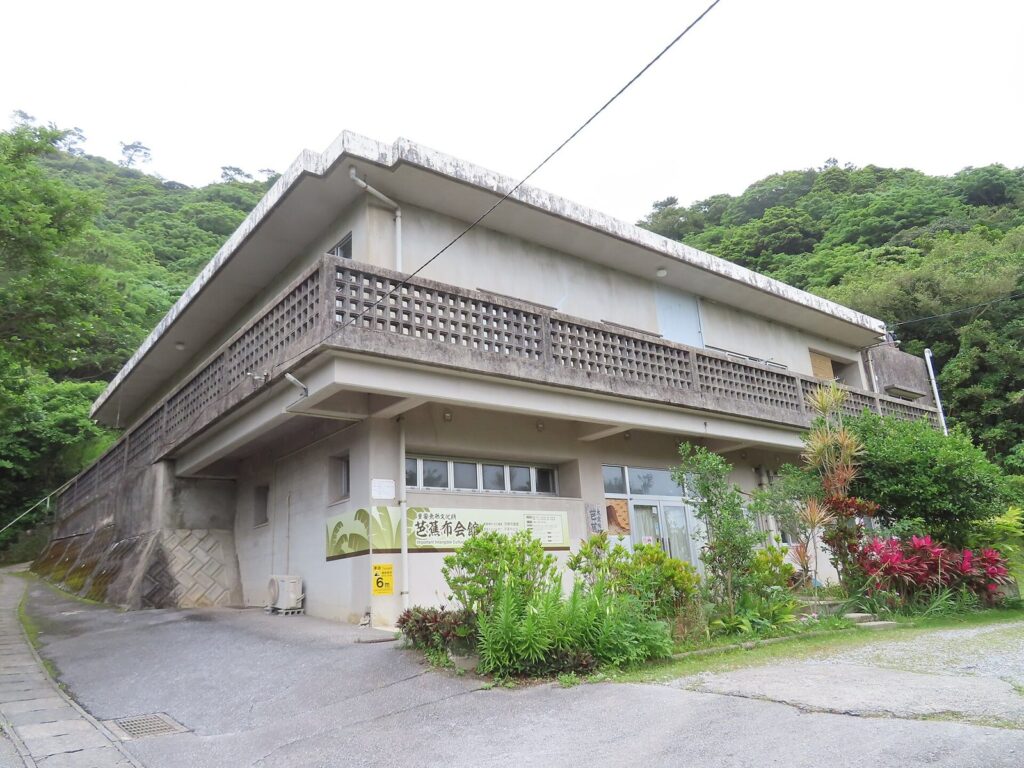
Visitors can see bashōfu at the Ōgimi Village Bashōfu Hall (大宜味村立芭蕉布会館) in Kijoka, which has exhibits on the craft. It is closed on Sundays, at lunar Obon and over the New Year; see our Kijoka bashōfu guide for hours and call ahead before you go (last checked: Oct 2026). Combine it with the forests and waterfalls of Northern Okinawa.
Tonbyan: A Lost Textile
Tonbyan (桐板, called tunban in Shuri) was a fine, translucent cloth worn as formal summer dress by the aristocratic class until the Second World War. Its thread was imported from China, and for decades no one was certain what it was made of. Agave, pineapple fibre and Chinese ramie were all proposed.
After the war the cloth was effectively lost. The weaver Rubbers-Miyahira Ginko (ルバース・ミヤヒラ吟子), working with her mother, the Shuri weaver Miyahira Hatsuko, spent about eight years studying and recreating it and concluded that the fibre was Chinese ramie. On Yonaguni, the certified traditional craftsperson Ukemasu Himeyo (請舛姫代) runs a workshop named Tunbyan and researches and promotes the textile. Tonbyan is not a designated craft, and you are unlikely to see it outside special exhibitions.
Jōfu, Hanaori and Minsā
Jōfu: Ramie from Miyako and Yaeyama
Jōfu means “superior cloth”. Miyako Jōfu is woven from ramie thread spun by hand so fine it is almost transparent, dyed in deep indigo with tiny kasuri patterns, then beaten with wooden mallets to give it a soft sheen. Yaeyama Jōfu is lighter in colour, with reddish-brown designs rubbed on with a dye from the kūru yam and fixed by bleaching in sea water and sun. To learn more about the islands themselves, see our Miyako Islands and Yaeyama Islands guides.
Did you know? Two island textiles were recognised as national Important Intangible Cultural Properties in their own right: Miyako Jōfu in 1978 and Kumejima Tsumugi in 2004.
Hanaori: Flower Weaves
Hanaori (花織) means “flower weave”: small diamond- and cross-shaped motifs are raised on the surface by floating extra threads. Yomitanzan Hanaori had nearly disappeared after the war and was revived from 1964 by weavers led by Yonamine Sada (與那嶺貞). Chibana in Okinawa City and Haebaru in the south have their own designated hanaori traditions. Yomitan is easy to reach on a day out in Central Okinawa.
Minsā: The Five-and-Four Belt
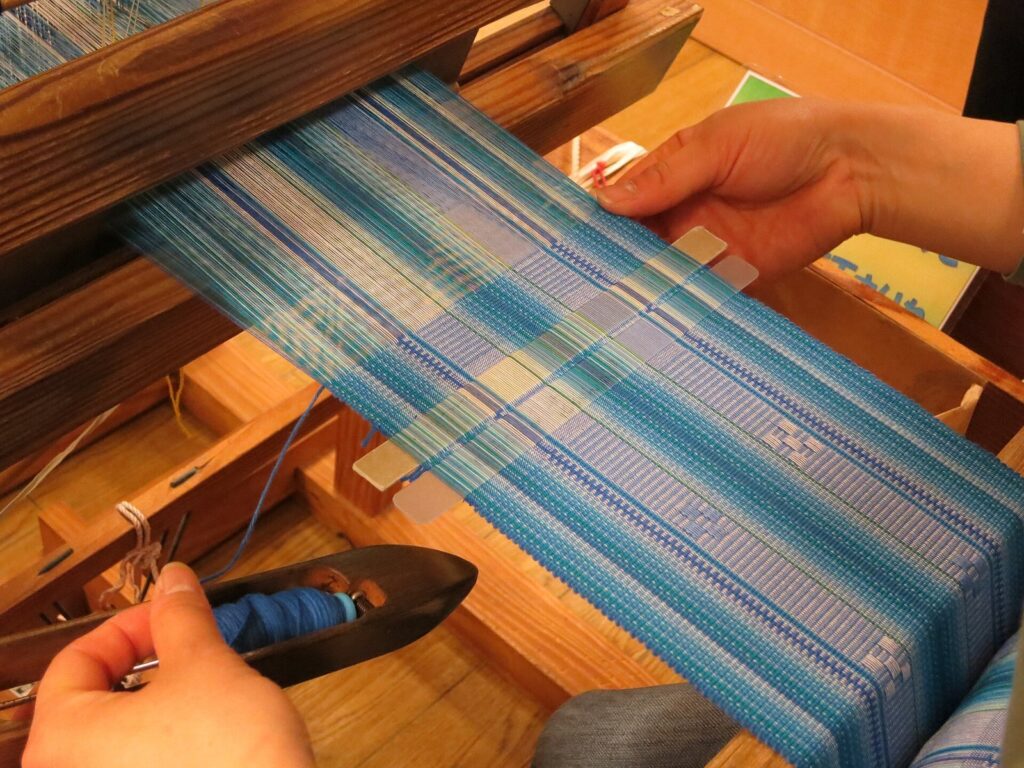
Yaeyama Minsā belts carry a row of five squares and a row of four. The Ishigaki maker Azamiya explains that the five and four carry the wish itsu no yo made mo, “for ever and always”, a play on the words for five (itsu) and four (yo). Minsā is now made into bags, coasters and table runners, and is a popular souvenir from Ishigaki and Taketomi.
Where to See, Buy and Try Ryukyuan Textiles
Many workshops are working studios, and experiences usually need booking ahead. Always check current opening days and reservation details on the official websites before you travel. Opening days below last checked: Oct 2026.
Naha
The Naha City Traditional Arts and Crafts Center (那覇市伝統工芸館) is on the second floor of Tenbusu Naha on Kokusai Street. It displays local crafts, sells work by Naha artisans and offers bookable bingata dyeing and Shuri-ori weaving experiences. The Okinawa Prefectural Museum & Art Museum in Omoromachi shows historic textiles and bingata in its rotating displays; it is closed on Mondays. See our Naha guide for more to do in the city.
For a personal glimpse of the craft, an early post on Marty’s Blog describes a 2007 visit to a Shuri-ori weaving school below Shuri Castle.
Yomitan
The Yomitan Traditional Crafts Center (読谷村伝統工芸総合センター) introduces Yomitanzan Hanaori and Minsā and offers hanaori coaster weaving by reservation.
Kumejima
Kumejima Tsumugi no Sato Yuimāru-kan (久米島紬の里 ユイマール館) in Maja shows how the silk is dyed and woven and offers weaving and dyeing experiences. It is closed on Wednesdays. Kumejima is a short flight or a ferry ride from Naha; see Getting Around Okinawa.
Miyako, Ishigaki and Yonaguni
- Miyakojima City Traditional Crafts Center (宮古島市伝統工芸品センター) displays Miyako Jōfu, and on weekdays you can usually watch weaving in progress. For a hands-on session, the Miyakojima Taiken Kōgeimura craft village offers weaving and indigo-dyeing experiences.
- Azamiya Minsā Kōgeikan (あざみ屋みんさー工芸館) in Ishigaki has exhibits, a shop and a minsā weaving experience.
- On Yonaguni, the Yonaguni Town Traditional Crafts Hall (与那国町伝統工芸館), is the base for Yonaguni Ori; you can watch weaving there and try it by reservation.
Etiquette for Workshop Visits
- Treat workshops as workplaces. Speak quietly and keep a little distance from weavers at the loom.
- Ask before taking photos. Some venues, including the Bashōfu Hall, restrict photography inside.
- Do not touch looms, threads or finished cloth unless staff invite you to.
- Book experiences ahead, arrive on time and tell staff in advance if you need English help.
Buying Tips: How to Spot the Real Thing
Handwoven Okinawan cloth takes weeks or months to make, and a full kimono bolt is a serious investment. Set a budget before you shop, and ask questions.
- Look for the 伝統証紙 (dentō shōshi). This certification sticker, with a gold “伝” mark, appears only on products of METI-designated crafts that have passed inspection in the production area.
- Check for the prefectural inspection seal. Okinawa Prefecture inspects textiles, and approved bolts carry a seal reading 県織物検査済之証.
- Check the producer labels. Many cooperatives add their own label. Kumejima Tsumugi, for example, carries a cooperative label marked 久米島紬事業協同組合証票, and genuine Amami Ōshima Tsumugi has a globe mark woven into the start of the bolt. Each of our textile pages explains the labels to look for.
- Buy from the source. Cooperatives, craft centres and their shops are the safest places to buy, and staff can explain how each piece was made.
- Know printed from handmade. Many affordable “bingata” and “minsā” souvenirs are machine-printed or machine-woven. They are fine gifts, but they are not the traditional craft.
- Ask about care. Silk, ramie and banana fibre each need different handling; most fine pieces should be dry-cleaned or washed gently by hand.
For more shopping and money advice, see Okinawa Budget & Costs.
Ryukyuan Textiles Abroad
Okinawan textiles have reached audiences far beyond Japan. In Washington, D.C., the George Washington University Museum and The Textile Museum presented Bingata! Only in Okinawa from November 2016 to January 2017, in partnership with the Okinawa Prefectural Government. In 2025, the Sainsbury Institute for the Study of Japanese Arts and Cultures and Okinawa Prefectural University of Arts held Okinawan Kōgei: Crafting Continuity and Change at the Crypt Gallery in Norwich, England, from late October to early November.
Frequently Asked Questions
What are Ryukyuan textiles?
Ryukyuan textiles are the traditional woven and dyed cloths of Okinawa and the Ryukyu Islands, including bingata, bashōfu, jōfu, kasuri, tsumugi, hanaori and minsā. Okinawa Prefecture has 13 textiles designated as Traditional Crafts by Japan’s Ministry of Economy, Trade and Industry.
What is the difference between bingata and bashōfu?
Bingata is a dyeing technique: colourful designs are stencilled onto cloth with rice-paste resist and brushed-on pigments. Bashōfu is a woven cloth made from the fibre of the thread-banana plant, centred on Kijoka in Ōgimi Village.
Where can I try weaving or bingata dyeing in Okinawa?
The Naha City Traditional Arts and Crafts Center at Tenbusu Naha offers bingata and Shuri-ori experiences. The Yomitan Traditional Crafts Center, Kumejima’s Yuimāru-kan, Miyakojima Taiken Kōgeimura and Azamiya Minsā Kōgeikan in Ishigaki also run experiences. Book ahead.
How can I tell if an Okinawan textile is authentic?
Look for the 伝統証紙 certification sticker with a gold 伝 mark, which is used for inspected products of designated Traditional Crafts, and for Okinawa Prefecture’s textile inspection seal. Many cooperatives also add their own labels, such as the Kumejima Tsumugi cooperative label.
Is Amami Ōshima Tsumugi an Okinawan textile?
No. Amami Ōshima Tsumugi comes from the Amami Islands in Kagoshima Prefecture. It is closely related to Ryukyuan weaving but is a Kagoshima craft.
Who was Taira Toshiko?
Taira Toshiko (1921–2022) led the postwar revival of bashōfu in Kijoka. She represented the group recognised when Kijoka no Bashōfu became an Important Intangible Cultural Property in 1974 and was certified individually as a holder, a Living National Treasure, in 2000.
Once you know a little about Ryukyuan textiles, you will see them everywhere in Okinawa, from dancers’ costumes to the belt in a shop window. Better still, sit at a loom yourself. Continue exploring in our Culture & History guides or start planning your route in Destinations.
Sources & Further Reading
Facts in this guide and its 18 textile pages were checked against the sources below, most of them official Japanese-language pages from the prefecture, the Agency for Cultural Affairs, producers’ cooperatives and museums. Each textile page lists its own sources in full.
Sources used for this overview
- Association for the Promotion of Traditional Craft Industries: list of METI-designated traditional crafts (PDF, Japanese)
- Okinawa Prefecture: list of Important Intangible Cultural Properties and holders (PDF, Japanese)
- Okinawa Prefecture: textile inspection and the traditional craft certification sticker (PDF, Japanese)
- National Crafts Museum (MOMAT): exhibition on Taira Toshiko and Kijoka bashōfu (Japanese)
- Yonaguni Town: Yonaguni Ori (Japanese)
- Nakagawa Masashichi: interview with Rubbers-Miyahira Ginko on tonbyan (Japanese)
- Amami City: Amami Ōshima Tsumugi (Japanese)
- The George Washington University Museum and The Textile Museum: Bingata! Only in Okinawa (English)
- Kagoshima Prefecture, Ōshima Branch Office: Amami Islands overview, history of administration (沿革) (PDF, official, Japanese)
- Kotobank: Amami Islands (奄美諸島) (Japanese)
Government, cultural-property and museum sources
- Okinawa Kōgei no Mori: Ryukyu Bingata (prefectural craft centre, Japanese)
- Okinawa Prefecture: Overview of craft industry policy, FY2024 (production-area profiles and holder lists as of June 2024) (official, Japanese)
- Agency for Cultural Affairs, Database of National Cultural Properties: Bingata (紅型) (official, Japanese)
- Okinawa Prefecture: list of designated cultural properties and holders (2021) (PDF, Japanese)
- Okinawa Kōgei no Mori: Kijoka no Bashōfu (prefectural craft centre, Japanese)
- Agency for Cultural Affairs, Database of National Cultural Properties: Kijoka no Bashōfu (official, Japanese)
- National Crafts Museum (MOMAT): exhibition on Taira Toshiko and Kijoka bashōfu (Japanese)
- Okinawa Kōgei no Mori: Shuri ori (prefectural craft centre, Japanese)
- Agency for Cultural Affairs, Database of National Cultural Properties: Shuri no Orimono (official, Japanese)
- Okinawa Kōgei no Mori: Ryukyu Kasuri and Haebaru Hanaori (prefectural craft centre, Japanese)
- Okinawa Kōgei no Mori: Chibana Hanaori (prefectural craft centre, Japanese)
- Okinawa Kōgei no Mori: Chibana Hanaori Business Cooperative (history, access) (prefectural craft centre, Japanese)
- Okinawa Kōgei no Mori: Yomitanzan Hanaori and Yomitanzan Minsā (prefectural craft centre, Japanese)
- Okinawa Kōgei no Mori: Yomitanzan Hanaori Business Cooperative (history, labels, access) (prefectural craft centre, Japanese)
- Yomitan Village: Traditional Crafts Center (hours, experience) (official, Japanese)
- Okinawa Kōgei no Mori: Kumejima Tsumugi (prefectural craft centre, Japanese)
- Okinawa Kōgei no Mori: Kumejima Tsumugi Business Cooperative (prefectural craft centre, Japanese)
- Agency for Cultural Affairs, Database of National Cultural Properties: Kumejima Tsumugi (official, Japanese)
- Okinawa Kōgei no Mori: Miyako Jōfu (prefectural craft centre, Japanese)
- Okinawa Kōgei no Mori: Miyako Textile Business Cooperative (history, access) (prefectural craft centre, Japanese)
- Agency for Cultural Affairs, Database of National Cultural Properties: Miyako Jōfu (official, Japanese)
- Okinawa Kōgei no Mori: Yaeyama Jōfu and Yaeyama Minsā (prefectural craft centre, Japanese)
- Okinawa Kōgei no Mori: Ishigaki City Textile Business Cooperative (history, access) (prefectural craft centre, Japanese)
- Ishigaki City: Related facilities (Traditional Crafts Hall) (official, Japanese)
- Okinawa Kōgei no Mori: Taketomi Town production area (prefectural craft centre, Japanese)
- Okinawa Kōgei no Mori: Taketomi Town Textile Business Cooperative (history, access) (prefectural craft centre, Japanese)
- Okinawa Prefecture: Traditional craft ordinance designation tables (official, Japanese, PDF)
- Okinawa Kōgei no Mori: Yonaguni Ori (prefectural craft centre, Japanese)
- Okinawa Kōgei no Mori: Yonaguni Town Traditional Textile Cooperative (history, access) (prefectural craft centre, Japanese)
- Yonaguni Town Board of Education: Traditional crafts of Yonaguni (the four textiles) (official, Japanese)
- Okinawa Prefecture Yonaguni tourism site: Traditional Crafts Hall (hours, experience) (official, Japanese)
- Naha City Museum of History, Digital Museum: White weft-kasuri tonbyan robe (Fukuchi family collection) (official, Japanese)
- National Museum of Nature and Science, HITNET database: Shuri textile garments, including tonbyan (official, Japanese)
- Okinawa Prefectural Museum & Art Museum: Collection search (Japanese)
- Agency for Cultural Affairs, Cultural Heritage Online: Ryūkyū ai seizō (Ryukyu indigo production) (official, Japanese)
- Motobu Town: Izumi district (cultural properties) (official, Japanese)
- Okinawa Industrial Technology Center Research Report No. 17 (2014): Microbes in the production of precipitated indigo from Ryukyu indigo and Japanese indigo (official, Japanese, PDF)
- Amami City: Honba Amami Ōshima Tsumugi (types, process, labels) (official, Japanese)
- Kagoshima Prefecture: Honba Amami Ōshima Tsumugi Cooperative (visitor information) (official, Japanese)
- Tatsugo Town: Ōshima Tsumugi Village (official, Japanese)
- Ministry of Land, Infrastructure, Transport and Tourism: Overview of the Amami Islands (official, Japanese)
- Japan Traditional Craft Center (Aoyama Square): Honba Ōshima Tsumugi (Japanese)
- Association for the Promotion of Traditional Craft Industries: Honba Ōshima Tsumugi Traditional Industry Hall (Japanese)
Cooperatives, producers and craft centres
- Ryukyu Bingata Business Cooperative: What is Ryukyu bingata? (Japanese)
- Ryukyu Bingata Business Cooperative: History of Ryukyu bingata (Japanese)
- Ryukyu Bingata Business Cooperative: Quality labels (Japanese)
- Shuri Senshokukan suikara: experience programmes, hours and closing days (Japanese)
- Naha City Traditional Arts and Crafts Center (Japanese)
- The George Washington University Museum and The Textile Museum: Bingata! Only in Okinawa (English)
- Kijoka no Bashōfu (official site of the preservation society): About bashōfu (Japanese)
- Kijoka no Bashōfu: the 23 stages of production (Japanese)
- Kijoka no Bashōfu: FAQ (visiting, opening hours, buying) (Japanese)
- Kijoka no Bashōfu: Kijoka Bashōfu Preservation Society (Japanese)
- Naha Traditional Textile Business Cooperative: What is Shuri ori? (Japanese)
- Shuri Senshokukan suikara (Japanese)
- Ryukyu Kasuri Business Cooperative: History of Haebaru and its weaving (Japanese)
- Ryukyu Kasuri Business Cooperative: What is Ryukyu kasuri? (Japanese)
- Ryukyu Kasuri Business Cooperative: list of certified traditional craftspeople (Japanese)
- Ryukyu Kasuri Business Cooperative: Ryukyu Kasuri Kaikan opening hours and access (Japanese)
- Ryukyu Kasuri Business Cooperative: What is Haebaru hanaori? (Japanese)
- Chibana Hanaori Business Cooperative (official site) (Japanese)
- Yomitanzan Hanaori Business Cooperative: notices (closures, typhoons) (Japanese)
- Yomitanzan Hanaori Business Cooperative (official site, products) (Japanese)
- Kumejima Tsumugi Business Cooperative: dyeing and the seasonal cycle (Japanese)
- Kumejima Tsumugi Business Cooperative: finishing and mallet beating (Japanese)
- Kumejima Tsumugi Business Cooperative: kasuri names (Japanese)
- Kumejima Tsumugi Business Cooperative: Important Intangible Cultural Property (Japanese)
- Kumejima Tsumugi Business Cooperative: product labels (Japanese)
- Kumejima Tsumugi no Sato Yuimāru-kan: visitor information (Japanese)
- Miyakojima City Traditional Crafts Center (hours, products, labels) (Japanese)
- Miyako Textile Business Cooperative (Japanese)
- Azamiya Minsā Kōgeikan (history of Yaeyama jōfu and gunbō) (Japanese)
- Taketomi Town Chamber of Commerce: Festivals and cultural properties (minsā) (Japanese)
- Ryukyu Indigo Production Technique Preservation Society: About the society (Japanese)
- Ryukyu Indigo Production Technique Preservation Society: About Ryukyu indigo (Japanese)
- Ryukyu Indigo Production Technique Preservation Society: Indigo dyeing experience (Japanese)
- Ryukyu Indigo Production Technique Preservation Society: Access (Japanese)
- Honba Amami Ōshima Tsumugi Cooperative: History (Japanese)
- Honba Amami Ōshima Tsumugi Cooperative: About the cooperative (globe mark history) (Japanese)
- Honba Amami Ōshima Tsumugi Cooperative: Mud dyeing (Japanese)
- Honba Amami Ōshima Tsumugi Cooperative: Kasuri binding (Japanese)
- Honba Amami Ōshima Tsumugi Cooperative: Labels (Japanese)
- Ōshima Tsumugi Village (hours, admission, experiences) (Japanese)
Research, media and further reading
- Kodama Eriko, Ryūkyū Bingata (琉球紅型), ADP, 2012 (book, Japanese)
- Katrien Hendrickx, The Origins of Banana-fibre Cloth in the Ryukyus, Japan, Leuven University Press, 2007 (book, English)
- Yanagi Sōetsu, Bashōfu Monogatari (芭蕉布物語) (essay, Japanese)
- Tanaka Toshio and Tanaka Reiko, Okinawa Orimono no Kenkyū (沖縄織物の研究), Shikōsha, 1976 (book, Japanese)
- Kotobank: Yaeyama kōfu (gunbō), regional brand entry (Japanese)
- QAB News (28 June 2023): Yaeyama kōfu and sustainable craft (Japanese)
- Yonemura Hajime (2011), On pineapple fibre as the raw material of the Okinawan textile tonbyan, Association of Japanese Geographers (J-STAGE, Japanese)
- Nakagawa Masashichi Shōten Yomimono (2018, republished 2019): the reconstruction of tonbyan by Rubāsu Miyahira Ginko (magazine article, Japanese)
Books
- Tanaka Toshio and Tanaka Reiko, Okinawa Orimono no Kenkyū (沖縄織物の研究), Shikōsha, 1976. A classic two-volume study, in Japanese.
- Katrien Hendrickx, The Origins of Banana-fibre Cloth in the Ryukyus, Japan, Leuven University Press, 2007. An English-language study of bashōfu that argues for a southern Chinese origin.
- Kodama Eriko, Zusetsu Ryūkyū no Some to Ori (図説 琉球の染めと織り), Kawade Shobō Shinsha, 2005. An illustrated introduction, in Japanese.
- Kodama Eriko, Ryūkyū Bingata (琉球紅型), ADP, 2012. A survey of bingata, in Japanese.
- Yonamine Ichiko, Okinawa Senshoku Ōkoku e (沖縄染織王国へ), Shinchōsha (Tonbo no Hon), 2009. A visual guide to Okinawa’s dyeing and weaving, in Japanese.
Image credits
- A 19th-century bingata kimono, detail. Photo: The George Washington University Museum and The Textile Museum, public domain, via Wikimedia Commons.
- Inside a bingata dyeing workshop (gallery). Photos: okinawa.com.
- A bashōfu kimono with stripes and yotsume kasuri. Tokyo National Museum. Photo: National Institutes for Cultural Heritage (ColBase), CC BY 4.0, via Wikimedia Commons.
- The Bashōfu Hall in Kijoka, Ōgimi. Photo: 運動会プロテインパワー, CC BY-SA 4.0, via Wikimedia Commons.
- Weaving minsā on Ishigaki. Photo: norio nakayama, CC BY-SA 2.0, via Wikimedia Commons.