Awamori (泡盛) is Okinawa’s own distilled spirit, made from rice, black koji mold and water and distilled once in a pot still. It has been made in the islands for more than 500 years, and Okinawa’s distillers call it Japan’s oldest distilled spirit. Locals also call it shimazake (島酒), “island liquor.”
This guide explains what awamori is and how it differs from shōchū. It covers its history, aged kusu, how people drink it, which distilleries you can visit, the islands’ other spirits, and how to bring bottles home. For the dishes it goes with, see our Okinawan food and drink guide.
What awamori is
Under Japanese law, awamori is a type of single-distilled shōchū (単式蒸留焼酎) with a narrow recipe. It is made from rice koji grown with black koji mold, plus water, fermented and distilled in a pot still. Nothing may be added except water. Three things set it apart:
- Black koji. The mold Aspergillus luchuensis (黒麹菌) takes its scientific name from Ryukyu and is designated one of Japan’s “national fungi.” It produces a lot of citric acid, which protects the mash from spoiling in Okinawa’s heat, so distillers can work year-round.
- All-koji, one-step fermentation. All the rice is made into koji. It is then mixed with water and yeast and fermented in a single stage for about two weeks, reaching about 18% alcohol.
- One distillation. Most distilleries distill once to keep the flavor of the mash. The spirit comes off the still at about 50%. It is then diluted, usually to 30–40%, and rested for six months to a year.
The rice is usually long-grain indica from Thailand. Distillers switched to it by the early 1920s, when local rice grew expensive. They found it firm and easy to handle, easy to keep at the right temperature while fermenting, and generous in alcohol. Broken rice was the norm until the late 2000s, when distillers moved to whole grains. A few now use Okinawan-grown rice.
Ryukyu Awamori. “Ryukyu” (琉球) is a geographical indication protected by the National Tax Agency. To use it, a spirit must use only A. luchuensis rice koji and water drawn in Okinawa, and be fermented, distilled, stored and bottled in the prefecture. Ryukyu Awamori (琉球泡盛) on a label means it was made in Okinawa.
Awamori and shōchū: the difference
Legally, awamori is a kind of shōchū, but it is made differently. Shōchū from Kyushu and elsewhere uses ingredients such as sweet potato, barley or rice, commonly with white or yellow koji. Its makers usually add the main ingredient to a koji starter in stages. Awamori allows only one recipe.
| Feature | Awamori | Mainland single-distilled shōchū |
|---|---|---|
| Main ingredient | Rice only, usually Thai indica | Sweet potato, barley, rice and others |
| Koji | Black koji only | Commonly white or yellow koji |
| Fermentation | One stage; all the rice is made into koji | Usually staged; main ingredient added to a koji starter |
| Strength | Up to 45%; everyday bottles mostly 25–30%. Yonaguni’s 60% hanazake is classed separately. | Up to 45% |
A short history
Origins. No one knows exactly how awamori began. Distilling probably reached the trading kingdom of Ryukyu in the fifteenth century. The long-favored theory, associated with the historian Higashionna Kanjun, traces it to Siam (Thailand) and its rice spirit lao khao. Okinawa’s distillers association notes that other research points to Fujian in China instead. Records by Chinese envoys, Korean castaways and Satsuma samurai show distilling had begun by the late 1400s. The name awamori first appears in 1671, in a list of gifts from King Shō Tei to the shōgun.
The royal monopoly. In the seventeenth and eighteenth centuries, the court allowed awamori to be made only in Shuri Sanka (首里三箇). These were three neighborhoods with good spring water less than 1 km from Shuri Castle: Sakiyama, Akata and Torihori (崎山・赤田・鳥堀). About 40 licensed craftsmen, the shōchū-shoku (焼酎職), handed nearly all their output to the court, and unlicensed distilling could mean exile. The court served its awamori to envoys and at rituals. In 1853, Bayard Taylor of Commodore Perry’s expedition praised a drink served at Shuri as “old and mellow… somewhat like French liqueur.” It was very likely aged awamori.
War and revival. After the kingdom ended, private distilling spread, and by 1893 there were 447 distilleries. The Battle of Okinawa in 1945 destroyed Shuri, which had had 46 distilleries before the war. Family jars of old kusu were lost, some said to be 150 to 200 years old, and so were the distilleries’ own koji strains. In 1946 the U.S. military government opened five state-run distilleries. At the one in Shuri, Sakumoto Masayoshi of today’s Sakimoto Distillery found a straw mat in the ruins with live black koji still on it. He cultured it and shared it with other distillers, and private distilling resumed in 1949. In 1998, prewar koji samples were found preserved at the University of Tokyo. One of them had been collected in 1935 at Zuisen’s predecessor, and Zuisen revived it for an awamori called Usaki (御酒).
Today. After Okinawa’s 1972 return to Japan, awamori was classed as shōchū. In 1983 distillers won the right to print “awamori” on labels again. A reduced Okinawan liquor tax in place since 1972 is being phased out between 2024 and 2032. November 1 has been Awamori Day since 1989. In December 2024, UNESCO inscribed Japan’s traditional koji-based sake-making, awamori included, as Intangible Cultural Heritage.
Kusu: aged awamori
Whiskey and brandy take much of their flavor from wooden barrels. Awamori changes from within, so it keeps maturing in clay jars, tanks and even sealed bottles. With age it grows softer, sweeter and slightly thicker. Distillers describe notes of vanilla and caramel, and the National Tax Agency’s description of the Ryukyu indication also mentions an aroma like matsutake mushrooms.
What “kusu” on a label means. Under the industry’s fair labeling code, kusu (古酒) means awamori stored at least three years. The code was tightened in 2013 after improper labels at nine distilleries came to light, and the new rules applied fully from August 1, 2015:
- A bottle labeled kusu must be 100% kusu. Before 2015, just over half was enough.
- An age such as “10 years” applies to every drop. In a blend, the youngest spirit sets the age.
- Regular awamori with at least 10% kusu may be sold as a blend, with the percentage stated.
- Age counts from inspection after distilling to bottling, so time on your shelf doesn’t change the label.
Since September 2021, a voluntary standard has applied the same rules to spirits above 45%.
Shitsugi. The traditional way to keep kusu is shitsugi (仕次ぎ), similar to the solera system used for sherry. Spirits of different ages sit in a row of jars. When some of the oldest is drunk, it is topped up from the next oldest, and so on down the line. The youngest jar is refilled with new awamori. Done well, this keeps a kusu going for generations. Some families start a jar when a child is born, and at weddings a couple may blend awamori from both families.
The oldest surviving awamori belongs to Shikina Distillery in Shuri Akata. To protect them from the war, the family buried three jars deep in the yard. Two survived: one said to be about 150 years old and one about 130. They are kept as heirlooms.
How Okinawans drink it
The everyday way is mizuwari, with water and ice. It is also served on the rocks, with soda, with hot water (which brings out a toasted-rice aroma), or with shīkwāsā citrus juice. Fine kusu is sipped straight. Everyday bottles in Okinawa are usually 30%, and many sold outside the prefecture are 25%.
Awamori is offered at utaki sacred groves, family tombs and household altars, as our religion and spirituality page describes. It is also served at weddings and at the summer rites for the ancestors. On Miyako, groups still drink in the otōri (オトーリ) style: people sit in a circle, and each in turn gives a short speech and pours a round. In the kitchen, awamori flavors rafute braised pork, the chili condiment kōrēgusu and the fermented tofu tōfuyō.
Most traditional awamori vessels are Tsuboya pottery, covered in our Okinawan pottery guide. For more Okinawan words, see the glossary and our Okinawan language page.
| Vessel | What it is for |
|---|---|
| Karakara カラカラ | A squat, flat-bottomed pourer that is hard to tip over; the standard server in restaurants. |
| Chibuguwā ちぶぐゎー | A cup barely bigger than a thimble, for sipping the finest kusu. |
| Yushibin 嘉瓶 | A large gourd-shaped bottle for bringing awamori to a celebration as a gift. The host pours it out and returns the bottle. |
| Dachibin 抱瓶 | A crescent-shaped flask with a shoulder cord, for carrying a personal supply. |
| Kame (jar) 甕 | An unglazed storage jar for aging kusu and keeping shitsugi at home. |
Distilleries you can visit
Okinawa has about 47 awamori distilleries making more than 1,000 brands, according to the distillers association’s 2019 figures. Many have a shop, and some offer tours and tastings. Details below come from each distillery’s own page, or the local tourism body where noted, as of November 13, 2026. Hours change with production, so check before you go. Tastings are for adults 20 and over, so don’t plan to drive.
| Distillery | Where | Visiting (as of November 13, 2026) |
|---|---|---|
| Zuisen Distillery 瑞泉酒造 | Shuri Sakiyama, Naha; 2 minutes’ walk from Shuri Castle’s Keisei Gate | Shop 9:00–17:00, closed public holidays. Free 10-minute film with English subtitles and free kusu tastings. Last entry 16:30 weekdays, 16:00 Saturdays; no tours Sundays. Groups of five or more book two business days ahead. |
| Chuko Distillery, Chukō-gura 忠孝酒造 忠孝蔵 | Iraha, Tomigusuku, south of Naha | Free tour at 10:00 and 14:00, up to 8 people, about an hour, including its jar-making kiln and wooden kusu store, then free tastings. Open 9:00–17:30; closed Thursdays and January 1. Booking recommended; required for 10 or more. |
| Kamimura Distillery 神村酒造 | Ishikawa, Uruma, central Okinawa | Reservation required 3 days to 3 months ahead. About 40 minutes with tasting, 10:00–16:00, 1 to 25 people. |
| Yamakawa Distillery 山川酒造 | Motobu, northern Okinawa | Phone reservation, five people or fewer, Monday–Friday 14:00–16:00, 30–50 minutes. ¥1,000 tour, or ¥3,000 with tasting and a 180 ml bottle of five-year kusu. |
| Seifuku Distillery 請福酒造 | Miyara, Ishigaki Island | Per the Ishigaki tourism association: free 15-minute tour at 11:00, 13:30 and 16:00, no booking needed. Shop 10:00–17:00. Closed weekends and holidays. |
| Kokusen Awamori 国泉泡盛 | Yonaguni Island | Maker of the 60% hanazake Donan. Tours possible; phone ahead. |
| Mizuho Distillery 瑞穂酒造 | Shuri, Naha; founded 1848 | Tours of its Tenryū-gura storehouse are suspended. |
Zuisen is the easiest to fit into a day of sightseeing, a short walk from Shuri Castle in the old Shuri Sanka district.
Chukō-gura, south of Naha, shows both distilling and jar making.
Famous awamori brands
We found no published sales figures for individual brands, so this list starts with the makers that sell the most. Teikoku Databank’s 2024 ranking of Japan’s shōchū and awamori makers lists four Okinawan companies in the national top 50. The rest are brands known for their history, a distinctive style or awards. All details come from the makers’ own pages and the reports cited below.
| Brand | Distillery and island or town | Style or ABV notes | Why it’s known |
|---|---|---|---|
| Kumejima no Kumesen 久米島の久米仙 | Kumejima no Kumesen, Kume Island; founded 1949 | The flagship Brown is a 30% blend of 10% kusu and 90% regular awamori. | Okinawa’s top-selling awamori maker in Teikoku Databank’s 2024 ranking (27th in Japan, about ¥1.6 billion). |
| Zanpa 残波 | Higa Distillery, Yomitan; founded 1948 | Zanpa White is 25% and Zanpa Black is 30%. Both are made on a still the distillery designed itself, for a lighter taste aimed at newcomers. | Second among Okinawan makers in the same ranking (28th in Japan, about ¥1.59 billion). |
| Shimauta and Masahiro 島唄・まさひろ | Masahiro Distillery, Itoman; founded in Shuri in 1883 | Shimauta was launched in 1998 for markets outside Okinawa. The maker says it was the first awamori fermented with sake yeast, and it is blended with kusu. | Third among Okinawan makers in the ranking (30th in Japan, about ¥1.46 billion). The company was also called Higa Shuzō until 2015; it is not related to Zanpa’s maker. |
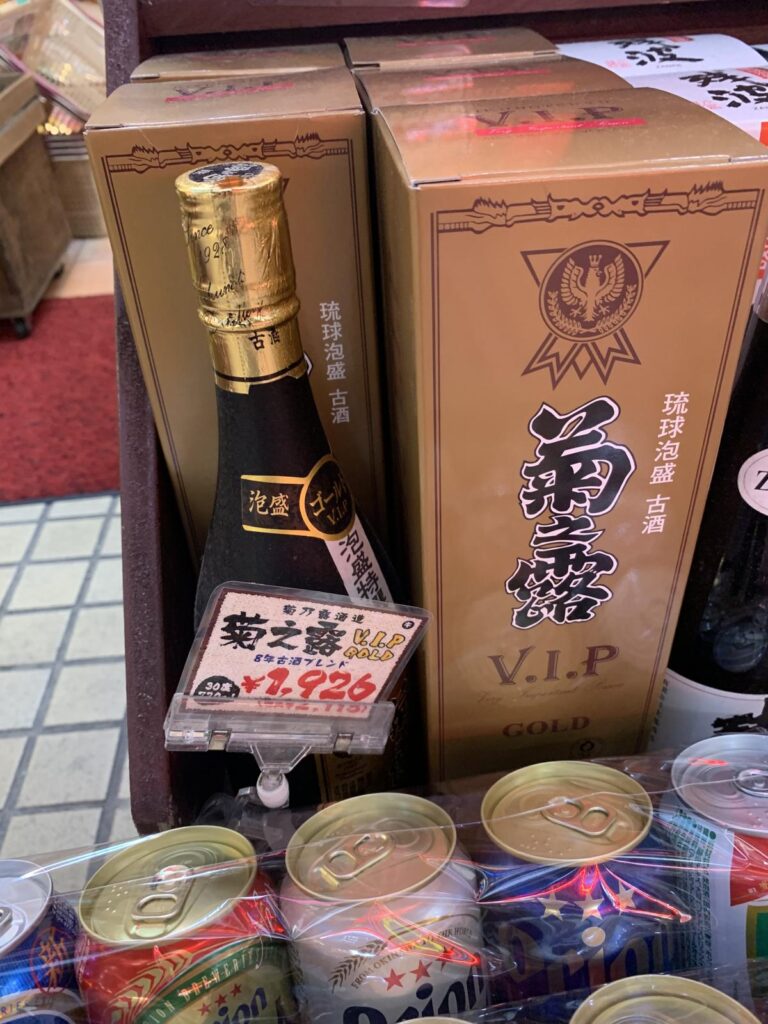
| Kikunotsuyu 菊之露 | Kikunotsuyu Distillery, Hirara, Miyako Island; founded 1928 | Kikunotsuyu Brown is an unaged 30% spirit made with Miyako’s hard water. The maker suggests drinking it with water or iced coffee. | A long seller across Okinawa. In 2023 the Okinawa Times described its maker, Kumejima no Kumesen and Higa Distillery as three of the top-selling awamori makers. |
| Kariyushi かりゆし | Shinzato Distillery, Uruma; founded in Shuri Akata in 1846 | A 30% everyday awamori, recently redesigned with a lighter, fresher taste. | The distillery calls itself Okinawa’s oldest. It was the fourth Okinawan company in the 2024 ranking (44th in Japan). |
| Zuisen and Usaki 瑞泉・御酒 | Zuisen Distillery, Shuri, Naha; founded 1887 | Usaki is fermented with the prewar black koji revived from University of Tokyo samples. It is sold young and as 10- to 21-year kusu. | A historic Shuri name with one of the largest kusu stocks in Okinawa. Zuisen Kusu won the Okinawa Governor’s Prize at the 2025 Awamori Competition. |
| Kura くら | Helios Distillery, Kyoda, Nago | A 25% three-year kusu aged in white oak barrels. The maker says it runs Okinawa’s only copper pot still. | On sale since 1991, Kura is a long-selling oak-aged awamori. Helios began in 1961 as a rum maker. |
| Danryu and Shurei 暖流・守禮 | Kamimura Distillery, Ishikawa, Uruma; founded in Naha in 1882 | Danryu blends spirit aged in ex-bourbon oak barrels with clear awamori. Danryu SHIP is 30% and Danryu CRAFT is 40%. Shurei is the distillery’s traditional line. | Danryu launched in 1968. The maker calls it the first awamori aged in whiskey barrels and the pioneer of barrel-aged awamori. |
| Donan どなん | Kokusen Awamori, Yonaguni Island | A 60% hanazake. Since 2020 it may be labeled awamori. | One of only three hanazake, all made on Yonaguni. |
| Awanami 泡波 | Hateruma Distillery, Hateruma Island | Made almost entirely by hand by one family, in small amounts. | So hard to find off the island that it is called a “phantom” awamori. |
Island spirits: hanazake and Hateruma
Yonaguni hanazake. Three distilleries on Yonaguni make hanazake (花酒), “flower spirit,” at 60%: Kokusen Awamori’s Donan, Sakimoto Distillery’s Yonaguni and Iriwanaguni Distillery’s Maifuna. The name comes from the way bubbles pile up like blossoms when strong spirit is poured. Above the 45% limit, tax law classes it as “raw-material alcohol.” Since April 2020, an exception lets it say “awamori” on the label, though it does not get the reduced Okinawan tax rate.
Hateruma’s Awanami. On Hateruma, the family-run Hateruma Distillery (波照間酒造所) makes Awanami (泡波) almost entirely by hand. So little is made that it is often called a “phantom” awamori off the island.
Beyond awamori: habushu, rum and more
Habushu (ハブ酒) is liquor made with the habu, Okinawa’s native pit viper; some souvenir bottles hold a whole snake. Nanto Shuzō, at the Okinawa World park in Nanjō, makes a 25% version. It blends habu extract with herb liqueurs on an awamori base. Some countries restrict wildlife products, so check before you buy.
Rum. Grace Rum, founded in 2004 on Minami Daitō Island, makes Corcor from local sugarcane. Ie Rum Santa Maria has been distilled on Ie Island since 2011 from island cane only, with tours by advance online booking. Several awamori houses also make whiskey, liqueurs and sparkling awamori. Okinawa’s Orion beer is covered in our food and drink guide.
Buying awamori and taking it home
Where to buy. Supermarkets, liquor stores and souvenir shops all sell awamori, and distillery shops often have kusu and limited bottlings. On the label, Ryukyu Awamori means made in Okinawa, kusu means 100% at least three years old, and any age shown is the youngest spirit in the bottle.
Tax-free shopping. Since November 1, 2026, Japan’s tax-free system for visitors works as a refund. You pay full price in the shop, then show your passport at a customs kiosk when you leave Japan, within 90 days of purchase. Once customs confirms the export, the shop refunds the consumption tax. Distilleries licensed for “sake brewery tourism” also refund the liquor tax on spirits they made themselves. Keep liquor sealed until you leave.
Flying with awamori. Japan’s transport ministry and its airlines set these limits:
- 24% alcohol or less: no limit.
- Over 24% and up to 70%: 5 liters per person in total, carry-on or checked, in retail packaging. Decanted spirits are not allowed. This covers most awamori, including 60% hanazake.
- Over 70%: not allowed at all.
On domestic flights, ANA suggests carrying glass bottles on board. International flights add carry-on liquid limits, so pack bottles well in checked bags. Your home country’s duty-free allowance applies on arrival. If you want a karakara or a jar, buy it empty. Our pottery guide has packing tips.
Drinking responsibly
The legal drinking age in Japan is 20. It stayed at 20 when the age of adulthood was lowered to 18 in 2022. Awamori is much stronger than beer or sake, so add water and pace yourself. If you are tasting at distilleries, don’t drive or cycle.
Frequently asked questions
Is awamori the same as sake?
No. Sake is brewed, while awamori is distilled with black koji. Everyday awamori is 25% to 30%, much stronger than sake.
How old is kusu?
At least three years. Since August 2015, the whole bottle must meet that age.
Can I take 60% hanazake on a plane?
Yes, within the 5-liter-per-person limit for drinks over 24% and up to 70%, in its retail packaging.
Sources and further reading
Facts were checked against the Japanese-language sources below in November 2026. Visiting details are as of November 13, 2026. The Okinawa Prefectural Distillers Association website (okinawa-awamori.or.jp) returned a server error throughout drafting. The association’s texts were read instead through the Japan Tourism Agency and MLIT multilingual database, where they are published under its name.
Definitions, law and labeling
- National Tax Agency, 「地理的表示『琉球』生産基準」 (revised September 14, 2020), nta.go.jp/…/180223_besshi03.htm. Government specification: black koji A. luchuensis, Okinawa water, all-koji method, production and bottling in Okinawa, kusu three years, shitsugi.
- Cabinet Office, 「注)1-21」, www5.cao.go.jp/…/chr04_chu1-21.html. Government note quoting the legal definition of awamori.
- Japan Sake and Shochu Makers Association, 「泡盛の表示に関する公正競争規約・施行規則」, honkakushochu-awamori.jp/…/awamori310401.pdf. Industry code (PDF): definition of awamori and kusu, 100% rule, youngest-age rule, blends, age counting.
- Ryukyu Shimpo, 「泡盛『古酒』表示 100%へ変更 完全適用15年8月」 (October 11, 2013), ryukyushimpo.jp/news/prentry-213651.html. Newspaper. 2013 change and 2015 full application.
- Ryukyu Shimpo, 「アルコール46度以上でも『泡盛』表記」 (September 6, 2020), ryukyushimpo.jp/news/entry-1186251.html. Newspaper. April 2020 exception for 46% and above; 1983 labeling; tax status.
- Ryukyu Shimpo, 「きょう『古酒の日』 与那国の花酒など45度超も『古酒』表示可能に」 (September 4, 2021), ryukyushimpo.jp/news/entry-1387180.html. Newspaper. Voluntary kusu standard for spirits above 45%.
- Okinawa Prefecture, 「35%軽減されていた酒税が2032年までに段階的に縮小」 (Churashima PR magazine), pref.okinawa.jp/…/chura590_6-7.pdf. Prefectural publication (PDF). Tax reduction phase-out.
Production, history and culture
- Japan Tourism Agency / MLIT multilingual database, Okinawa Prefectural Distillers Association texts (FY2019): R1-01300 (what awamori is, 47 distilleries), R1-01301 (black koji), R1-01302 (Thai rice), R1-01303 (origins, 1671), R1-01304 (Shuri Sanka, 447 distilleries in 1893), R1-01305 (production), R1-01306–R1-01309 (kusu, shitsugi, Zeni-gura), R1-01312–R1-01313 (Perry visit, rituals, otōri), R1-01316 (vessels). Official multilingual notes, Japanese and English.
- Okinawa Prefectural Archives, 「11月1日 泡盛の日」, archives.pref.okinawa.jp/news/that_day/15457. Prefectural archive. Shuri Sanka monopoly, private distilling from 1875–76, Awamori Day 1989.
- Sake Culture Institute, interview with Sakumoto Masaatsu of Zuisen, sakebunka.sub.jp/…/20sakumoto02.htm. Interview (1999). 46 prewar Shuri distilleries, 1946 state distilleries, the nikubuku koji, 1949 privatization, 1998 Tokyo strains.
- Zuisen Distillery, 「御酒(うさき)とは」, okinawa.zuisen.co.jp/usaki/about.html. Distillery page. 1935 sample, 1998 discovery, Shuri Sanka shōchū-shoku.
- Ryukyu Shimpo, 「沖縄で現存する『最古』150年物の泡盛古酒を訪ねた」 (August 30, 2018), ryukyushimpo.jp/living-style/entry-793755.html. Newspaper. Shikina Distillery’s buried jars.
- Awamori Shimbun, 「逸材探訪(波照間酒造所編)」 (2016), awamori-news.co.jp/…hateruma-shuzosho. Trade newspaper. Awanami, switch from broken to whole rice around 2010.
- Agency for Cultural Affairs, 「伝統的酒造り」, bunka.go.jp/…/94142301.html and online.bunka.go.jp/heritages/detail/621579. Government. UNESCO inscription, December 2024, including awamori.
- Japanese Wikipedia, 「泡盛」, ja.wikipedia.org/wiki/泡盛. Encyclopedia (secondary). Used only for orientation and cross-checks: common ways of drinking and bottle strengths, Higashionna’s theory, the end of broken-rice imports in the late 2000s.
Distilleries and other spirits
- Zuisen Distillery, 見学申込・売店, zuisen.co.jp/factory, and zuisen.co.jp. Distillery pages. Hours and visiting terms.
- Chuko Distillery, 酒蔵見学のご案内, chuko-awamori.com/chukogura/fieldtrip. Distillery page.
- Kamimura Distillery, 泡盛工場見学, kamimura-shuzo.co.jp/tour.html. Distillery page.
- Yamakawa Distillery, 蔵見学ご案内, yamakawashuzo.com/news/蔵見学. Distillery page.
- Ishigaki City Tourism Association, 請福酒造有限会社, yaeyama.or.jp. Tourism listing. The distillery’s own site, seifuku.co.jp, returned a server error at draft time.
- Kokusen Awamori, どなん オフィシャルサイト, kokusenawamori.ti-da.net. Distillery site.
- Mizuho Distillery, mizuhoshuzo.co.jp and contact page. Distillery site. Founded 1848; tours suspended.
- Nanto Shuzō, ハブ酒, nantosyuzo.com/habu and habu25. Maker’s pages.
- Grace Rum, 会社情報, rum.co.jp/company.php. Maker’s page. Founded March 2004, Minami Daitō.
- Ie Island Distillery, ブランドストーリー・蒸留所見学, ierum.ie-mono.com/story and ierum.ie-mono.com/visit. Maker’s pages. Founded 2011; booking-only tours.
Famous brands
- Teikoku Databank Fukuoka branch, 「焼酎メーカー売上高ランキング(2024年)」 (August 8, 2025), tdb.co.jp/…/2024.pdf. Credit research report (PDF). Top 50 shōchū and awamori makers by 2024 sales: Kumejima no Kumesen 27th, Higa Distillery 28th, Masahiro 30th, Shinzato 44th.
- Ryukyu Shimpo, 「焼酎売上高、2年ぶり減 サツマイモ伝染病響く 帝国福岡」 (August 9, 2025), ryukyushimpo.jp/news/economics/entry-4529945.html. Newspaper report of the same ranking.
- Okinawa Times, 「『全部おいしい』泡盛炭酸割り飲み比べ 3社合同の感謝祭」 (August 25, 2023), okinawatimes.co.jp/articles/-/1210521. Newspaper. Kumejima no Kumesen, Higa Distillery and Kikunotsuyu described as the top-selling awamori makers.
- Kumejima no Kumesen, 会社案内・ブラウン, k-kumesen.co.jp/company and lineup/1495449186. Maker’s pages.
- Higa Distillery, 残波のこだわり, zanpa.co.jp/about-9. Maker’s page.
- Masahiro Distillery, 会社概要・島唄, masahiro.co.jp/company and masahiro.co.jp/shimauta. Maker’s pages.
- Kikunotsuyu Distillery, 会社概要・菊之露ブラウン, kikunotsuyu.co.jp/company and kikunotsuyu-brown. Maker’s pages.
- Shinzato Distillery, 会社概要・かりゆし, shinzato-shuzo.co.jp/company and kariyushi. Maker’s pages.
- Zuisen Distillery, 会社紹介, zuisen.co.jp/shoukai. Maker’s page. Company history, Usaki, 2025 Awamori Competition prizes.
- Helios Distillery, 三年古酒 くら, helios-shop.jp/shopdetail/000000000001, and ヘリオス酒造の歴史と樽貯蔵へのこだわり, tour.helios-shop.jp. Maker’s pages.
- Kamimura Distillery, 暖流のこだわり, kamimura-shuzo.co.jp/tour-2/barrel-2, and kamimura-shuzo.co.jp. Maker’s pages. Danryu 1968, SHIP and CRAFT strengths, Shurei.
- Okinawa Prefectural Distillers Association, distillery listing for Hateruma Distillery, okinawa-awamori.or.jp/distilleries/hateruma. Industry body. Returned a server error at draft time; Hateruma Distillery has no website of its own. Details from the Awamori Shimbun interview (source 13).
Travel rules
- Ministry of Land, Infrastructure, Transport and Tourism, 「機内への持込み又はお預け手荷物に制限がある品目の代表例」 (updated April 24, 2026), mlit.go.jp/common/001425421.pdf. Government (PDF). Alcohol limits of 24%, 70% and 5 liters.
- ANA, 「【国内線】お酒は機内に持ち込むことはできますか。」, ana-support.my.site.com/…/answers2653ja. Airline FAQ.
- National Tax Agency, 「酒蔵ツーリズムにおける酒税免税制度」 (2026), nta.go.jp/…/2026/pdf/42.pdf, and 輸出酒類販売場制度, nta.go.jp/…/syuhanjyo. Government. Liquor tax exemption at distilleries and the refund system from November 1, 2026.
- Japan Customs, 「外国人旅行者向け免税制度について」, customs.go.jp/kaigairyoko/taxrefund/jpn.htm. Government. Refund system from November 1, 2026; customs check within 90 days.
- Government of Japan public relations, 「18歳から”大人”に成年年齢引下げで変わること、変わらないこと。」, gov-online.go.jp/article/201808/entry-7947.html. Government. Drinking age remains 20.