Amami Ōshima tsumugi (本場奄美大島紬) is a hand-woven silk from Amami Ōshima, an island in the Amami Islands of Kagoshima Prefecture, not Okinawa. It is famous for two things: a glossy black-brown made by dyeing silk dozens of times in techi-gi (sharinbai) and then in iron-rich mud, and extraordinarily fine kasuri made by first weaving the pattern threads tight on a special binding loom. The Amami Islands were once part of the Ryukyu world, which is why we include this textile as a close relative of Okinawa’s. You can see it made and try mud dyeing on Amami Ōshima.

This page is part of our guide to Ryukyuan textiles, which compares all of Okinawa’s woven and dyed crafts.
Amami Ōshima Tsumugi at a Glance
| Japanese | 本場奄美大島紬 (honba Amami Ōshima tsumugi, “genuine Amami Ōshima tsumugi”); the national designation name is 本場大島紬 (honba Ōshima tsumugi) |
| Place | Amami Ōshima and the Amami Islands, Kagoshima Prefecture. Ōshima tsumugi is also made in Kagoshima City and in Miyakonojō, Miyazaki Prefecture |
| Fibre | Silk (the national standard requires raw silk thread) |
| Key techniques | Shime-bata (締機) loom-bound kasuri; techi-gi dyeing and mud dyeing (泥染め, dorozome); hand-weaving on a takabata loom with kasuri aligned by needle |
| Designation | National Traditional Craft, Ministry of Economy, Trade and Industry, as 本場大島紬, 17 February 1975, listed under both Kagoshima and Miyazaki prefectures |
| Cooperative | Honba Amami Ōshima Tsumugi Cooperative (本場奄美大島紬協同組合), founded as a trade guild in 1901 |
Where It Comes From: Amami, Ryukyu and Satsuma
The Amami Islands lie between Kyushu and Okinawa, about 370–560 km (230–350 miles) south-west of Kagoshima City, and form part of the Ryukyu island arc. According to Japan’s Ministry of Land, Infrastructure, Transport and Tourism, all the islands came under the Ryukyu Kingdom around 1460. After Satsuma’s invasion of Ryukyu in 1609, Amami was separated from Ryukyu and placed directly under the Satsuma domain. From 1946 the islands were administered by the US military, before returning to Japan in 1953 as part of Kagoshima Prefecture.
That shared past shows in the cloth. Like Kumejima tsumugi, it is a kasuri silk dyed with sharinbai and mud, but it developed its own techniques under Satsuma rule and in the modern era.
History
Amami City says silk cloth has been made on the island for a very long time, and that hand-spun brown cloth may date back to the Nara period (8th century). The cooperative describes how, in the early Edo period, islanders wove tsumugi for themselves from hand-spun floss silk on a ground loom. Around 1720 Satsuma issued an order banning islanders from wearing tsumugi, and the cloth was made as tribute for the domain.
From the 1870s Ōshima tsumugi was traded on the open market and became hugely popular; the cooperative says the island’s distinctive mud dyeing became established around this time. Demand forced changes: from 1895 degummed tama-ito (練玉糸) silk was brought in because hand-spun thread could not keep up, and from about 1897 weavers switched to the faster takabata loom. In 1901 a trade guild, the forerunner of today’s cooperative, was set up to inspect cloth and protect its reputation, and by 1921 almost all Ōshima tsumugi was made of pure silk thread.
The binding loom that made the fine kasuri possible was developed in the early 20th century. The cooperative dates it to around 1902; the Japan Traditional Craft Center’s Aoyama Square credits Nagae Ieon (永江伊栄温) and his son in Kagoshima City with developing loom-binding in 1907. Ōshima tsumugi was designated a national Traditional Craft in 1975.
How Amami Ōshima Tsumugi Is Made
Amami City divides the work into nine main stages, each handled by a different specialist:
- Design: the pattern is drawn on graph paper, matched to the thread density.
- Thread preparation and warping: silk threads are measured to length and number.
- Starching: the threads are stiffened with a glue made from igisu seaweed and dried in the sun.
- Kasuri binding (締め): on the shime-bata binding loom, the silk that will form the pattern is woven tightly into a mat with a cotton warp, so the bound parts resist dye.
- Techi-gi dyeing: the silk is dyed red-brown in a decoction of chipped techi-gi.
- Mud dyeing: the silk is worked in a mud field; alternated many times with techi-gi dyeing, it turns a deep black-brown.
- Preparation: the cotton binding is removed, threads are separated and arranged to the design, and colours can be added by hand.
- Weaving: on a takabata loom, the weaver loosens the warp about every 7 cm (2¾ in) and lines up the kasuri thread by thread with a needle.
- Inspection: the cooperative checks every bolt; Amami City says inspectors check 24 points, including length, width, uneven kasuri and colour.
Mud Dyeing with Techi-gi
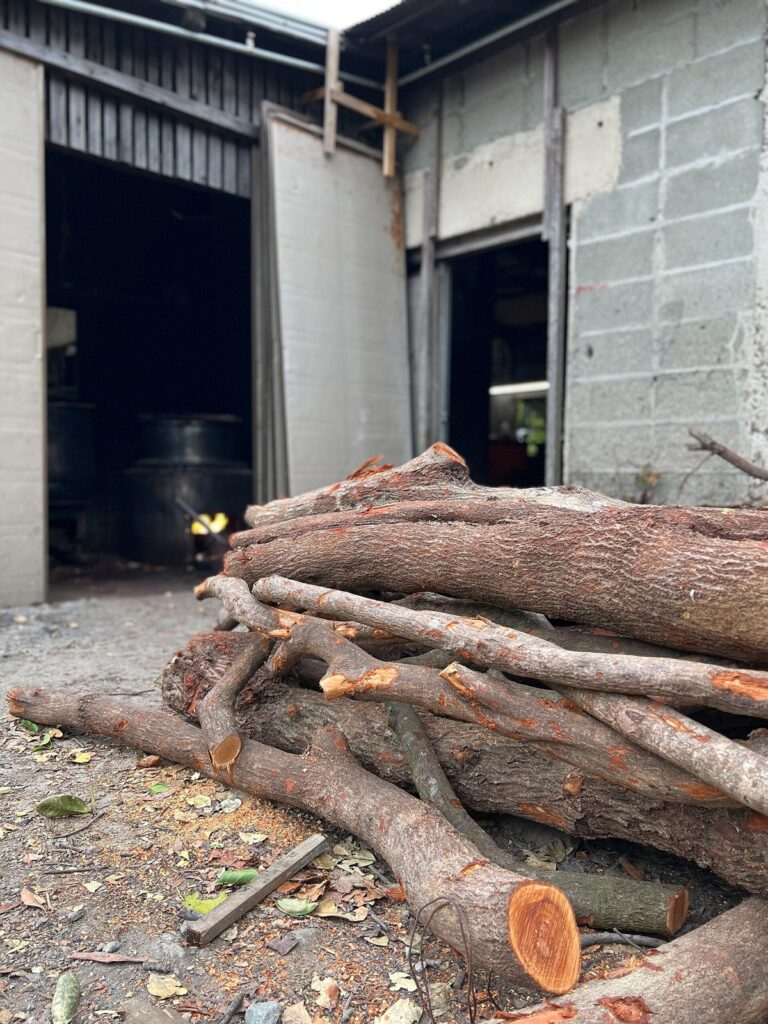
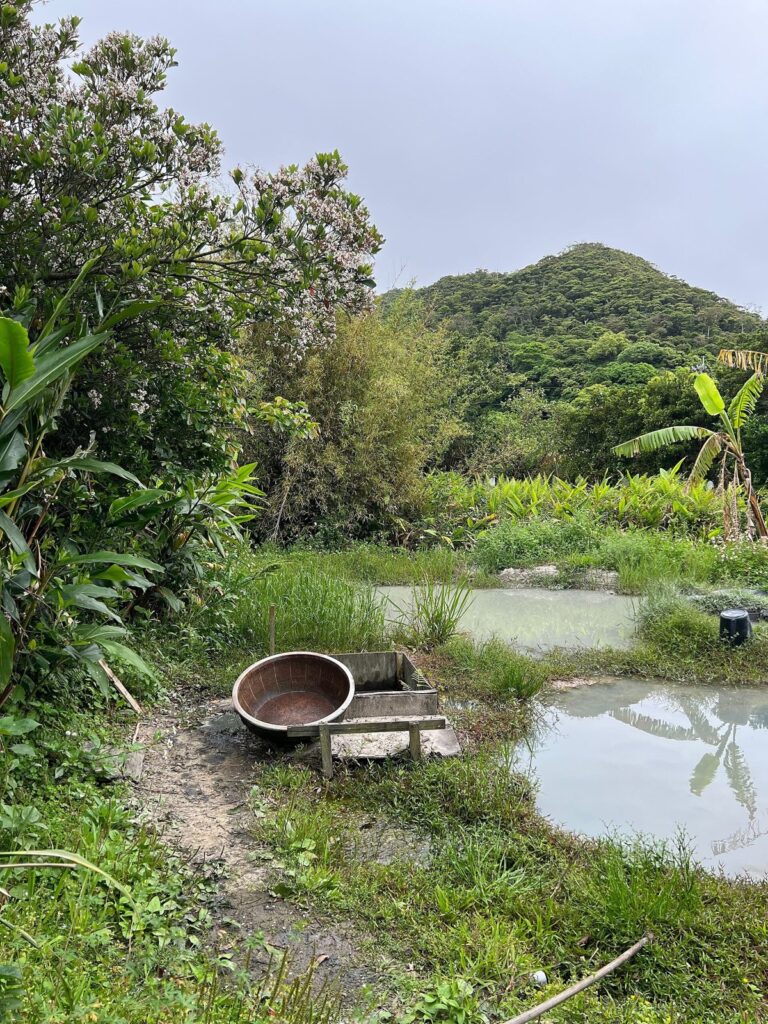
Mud dyeing (泥染め, dorozome) is the heart of the craft. Techi-gi (テーチ木) is the local name for sharinbai (Rhaphiolepis), a shrub rich in tannin. Its wood and roots are chopped and boiled; Aoyama Square says for about 14 hours. The silk is dyed in this liquid again and again until it turns red-brown, then taken to a mud field. The cooperative explains that iron in the mud reacts with the tannin, gradually turning the silk black. According to Aoyama Square, one cycle is about 20 dips in techi-gi followed by one in the mud, repeated three or four times, for around 100 dyeings in all.
Did you know? It is said that Ōshima tsumugi is woven twice. Aoyama Square explains that the pattern threads are first woven tight on the binding loom so they can be dyed, then unpicked and woven again into the finished cloth.
Types of Amami Ōshima Tsumugi
Amami City lists four main types:
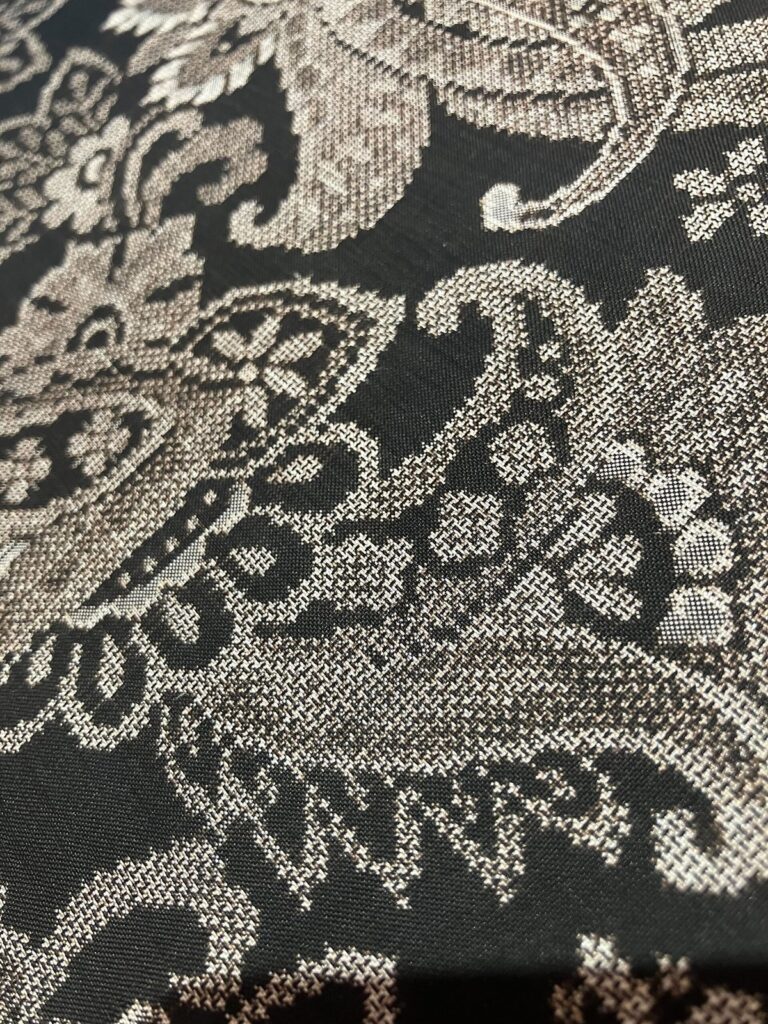
- Doro Ōshima (泥大島): dyed with techi-gi and mud, with a soft gloss and light-brownish white kasuri on black.
- Doro-ai Ōshima (泥藍大島): thread dyed first with plant indigo, then with techi-gi and mud, so the kasuri shows in indigo on black.
- Kusaki-dorozome Ōshima (草木泥染大島): dyed with natural dyes other than techi-gi and indigo.
- Iro Ōshima (色大島): kasuri in synthetic dyes, allowing bright and bold designs.
How to Tell Authentic Amami Ōshima Tsumugi
Amami City and Kagoshima Prefecture say every bolt of genuine Amami Ōshima tsumugi has a globe mark and the words 本場奄美大島紬 woven into the start of the cloth, and always carries the globe-mark trademark label. The cooperative lists the labels used on bolts that pass inspection, and stamps a pass mark only on those that do:
- the globe mark (地球印) trademark, proof of hand-weaving on Amami Ōshima;
- the production-area label (産地証紙), proof that it was made on Amami Ōshima;
- the mud-dyeing label (泥染証紙), for cloth dyed in Amami’s natural mud;
- the plant mud-dyeing label (草木泥染証紙), for cloth mud-dyed with plants other than techi-gi;
- and the national Traditional Craft label (伝統証紙).
The globe mark was chosen by public competition after Amami’s return to Japan, decided by the cooperative’s general meeting in 1954, and registered as a design on 24 January 1955, according to the cooperative.
Where to See, Buy and Try It
Ōshima Tsumugi Village, Tatsugo
The Ōshima Tsumugi Village (大島紬村) is a visitor garden and working factory in Tatsugo, where you can watch Ōshima tsumugi being made, walk through a subtropical garden and try mud dyeing in the mud fields.
- Address: 1945 Akaogi, Tatsugo Town, Ōshima District, Kagoshima (鹿児島県大島郡龍郷町赤尾木1945)
- Hours: 9:00–17:00 (16:00 on shortened days); shop last entry 16:30.
- Closed: the day of the lunar Obon send-off, and 31 December and 1 January; may close when typhoons approach.
- Admission: adults ¥550, elementary and junior high school students ¥220; the shop alone is free. Phone: 0997-62-3100.
- Mud dyeing: by reservation. The village announced revised mud-dyeing fees from 1 September 2026, so check current prices when you book. Weaving experiences are by enquiry.
The Cooperative in Naze
The Honba Amami Ōshima Tsumugi Cooperative (本場奄美大島紬協同組合) is in Naze, the centre of Amami City, at 48-1 Urakami-chō (奄美市名瀬浦上町48-1), about 700 m from Amami City Hall. Kagoshima Prefecture lists its hours as 8:30–17:00; phone 0997-52-3411. The national Traditional Craft association also lists a Honba Ōshima Tsumugi Traditional Industry Hall on the same phone number, with free admission, products on display and weaving experiences, but gives a different address in Minato-machi. Call ahead to confirm what is open to visitors.
Practical details in this section last checked: Oct 2026.
Frequently Asked Questions
Is Amami Ōshima tsumugi from Okinawa?
No. It comes from Amami Ōshima in the Amami Islands, which belong to Kagoshima Prefecture. The islands were part of the Ryukyu Kingdom until 1609, then under Satsuma.
What is mud dyeing (dorozome)?
Silk is dyed red-brown with techi-gi (sharinbai) and then worked in iron-rich mud. Iron reacts with the tannin and, after many repetitions, the silk turns a deep black-brown.
How can I tell genuine Amami Ōshima tsumugi?
Look for the globe mark and 本場奄美大島紬 woven into the start of the bolt, and the globe-mark trademark label. Mud-dyed cloth also carries a mud-dyeing label.
Can I try mud dyeing on Amami Ōshima?
Yes. Ōshima Tsumugi Village in Tatsugo offers mud-dyeing experiences by reservation.
What is the difference between Ōshima tsumugi and Amami Ōshima tsumugi?
The national designation name is Honba Ōshima tsumugi, which also covers cloth made in Kagoshima City and Miyakonojō in Miyazaki. Honba Amami Ōshima tsumugi is the name used for cloth made in the Amami Islands.
Sources & Further Reading
Facts on this page were checked against these sources. Most are official Japanese-language pages from the prefecture, the Agency for Cultural Affairs, producers’ cooperatives and museums.
Official and cooperative sources (Amami and Kagoshima)
- Honba Amami Ōshima Tsumugi Cooperative: History (Japanese)
- Honba Amami Ōshima Tsumugi Cooperative: About the cooperative (globe mark history) (Japanese)
- Honba Amami Ōshima Tsumugi Cooperative: Mud dyeing (Japanese)
- Honba Amami Ōshima Tsumugi Cooperative: Kasuri binding (Japanese)
- Honba Amami Ōshima Tsumugi Cooperative: Labels (Japanese)
- Amami City: Honba Amami Ōshima Tsumugi (types, process, labels) (official, Japanese)
- Kagoshima Prefecture: Honba Amami Ōshima Tsumugi Cooperative (visitor information) (official, Japanese)
- Tatsugo Town: Ōshima Tsumugi Village (official, Japanese)
- Ōshima Tsumugi Village (hours, admission, experiences) (Japanese)
National sources
- Ministry of Land, Infrastructure, Transport and Tourism: Overview of the Amami Islands (official, Japanese)
- Japan Traditional Craft Center (Aoyama Square): Honba Ōshima Tsumugi (Japanese)
- Association for the Promotion of Traditional Craft Industries: Honba Ōshima Tsumugi Traditional Industry Hall (Japanese)
Image credits
- The Honba Amami Ōshima Tsumugi Kaikan, March 2024. Photo: Sugar ws, CC0, via Wikimedia Commons.
- Cut techi-gi (sharinbai) wood waiting to be made into dye for Ōshima tsumugi, 2022. Photo: Markmcnbowe97, CC0, via Wikimedia Commons.
- A mud-dyeing field at the Kanai dyeing workshop on Amami Ōshima, 2022. Photo: Markmcnbowe97, CC0, via Wikimedia Commons.
- Detail of a hand-woven Ōshima tsumugi kimono, 2024. Photo: Markmcnbowe97, CC BY-SA 4.0, via Wikimedia Commons.