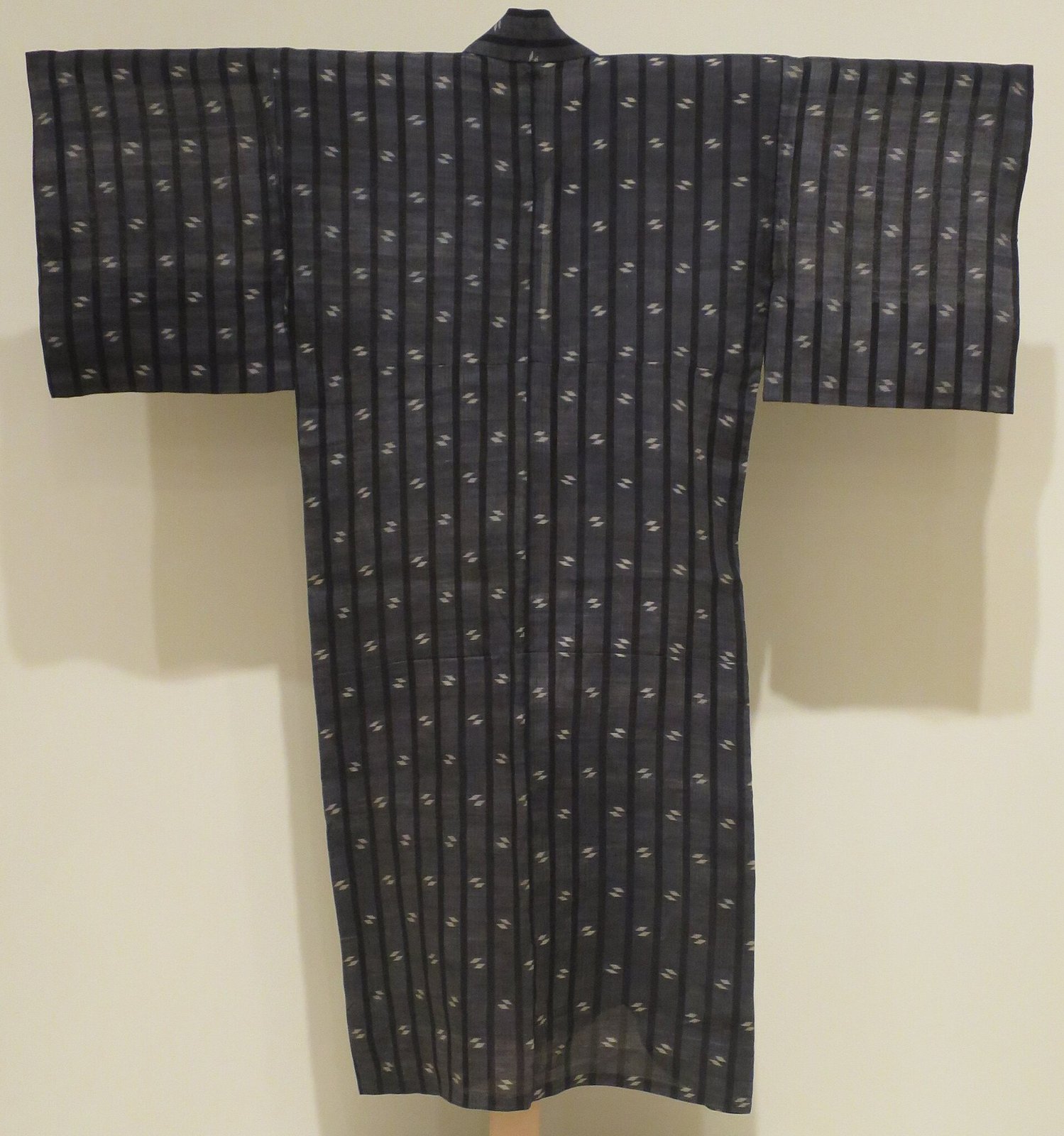
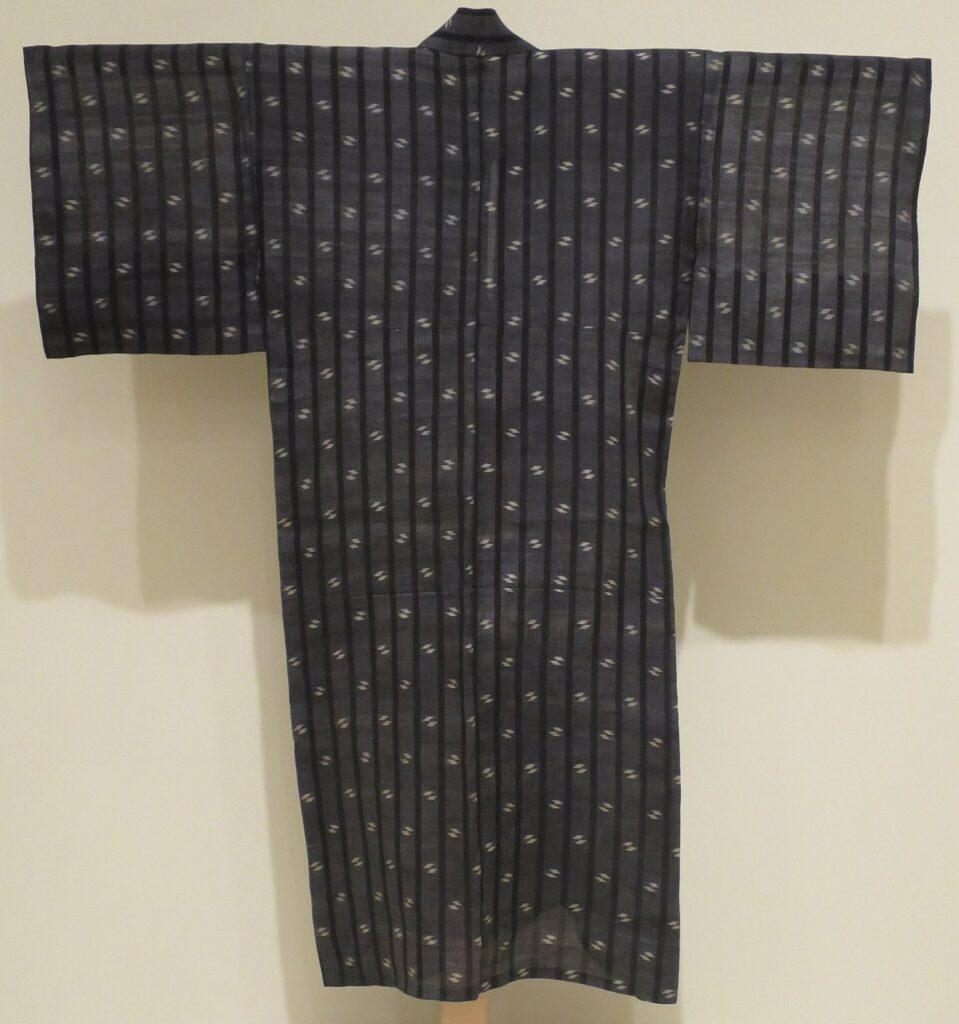
Ryukyu kasuri (琉球絣) is Okinawa’s ikat cloth, woven with threads that are tied and dyed before weaving so that crisp geometric patterns appear in the finished fabric. Today it is made almost entirely in Haebaru and neighbouring Yaese in the south of Okinawa’s Main Island, mostly in silk. It draws on a stock of around 600 traditional motifs with homely names like “little bird” and “carpenter’s square”, and it is the largest textile industry in Okinawa by production value. Visitors can see it at the Ryukyu Kasuri Kaikan in Haebaru.
This page is part of our guide to Ryukyuan textiles, which compares all of Okinawa’s woven and dyed crafts.
Ryukyu Kasuri at a Glance
| Japanese | 琉球絣 (Ryūkyū kasuri), also written 琉球かすり |
| Technique | Kasuri (ikat): threads tied by hand at calculated intervals, dyed, then woven so the pattern lines up |
| Fibres | Silk, cotton and ramie; now mostly silk |
| Made in | Haebaru (Kyan, Motobu and Teruya districts) and Yaese (Kochinda), with some in Naha |
| Designations | Okinawa Prefecture traditional craft product (1974); national Traditional Craft, Ministry of Economy, Trade and Industry (27 April 1983) |
| Cooperative | Ryukyu Kasuri Business Cooperative (琉球絣事業協同組合), founded 1975 |
What Is Kasuri?
Kasuri is the Japanese name for ikat. Before weaving, the weaver’s team binds small sections of thread tightly so that dye cannot reach them, dyes the thread, and then unbinds it. When the threads are woven, the undyed sections line up to form the pattern. Because the motif exists in the thread before the cloth is made, the edges of each shape have a characteristic soft, slightly blurred look.
History
From India to Okinawa
The Haebaru cooperative traces kasuri to India, pointing to 7th-century wall paintings in the Ajanta caves that appear to show people wearing ikat cloth. The technique spread across Asia and, the cooperative says, reached Okinawa in the 14th–15th centuries with the kingdom’s great age of trade. It also claims Ryukyu kasuri as a root of mainland Japanese kasuri, including Satsuma, Kurume, Yonezawa Ryukyu and Iyo kasuri.
The prefecture links Ryukyu kasuri as an industry to cotton: in 1611 the official Gima Shinjō (儀間真常) is said to have brought cotton seeds back from Satsuma and grown them in the Kakinohana area. Kasuri began as cotton cloth; silk kasuri was introduced around 1935 and now makes up most production.
Royal pattern books and a commoners’ rule
In the kingdom era, court painters drew kasuri designs collected in the mi-ezu-chō (御絵図帳), and women in Shuri, Naha, Miyako, Yaeyama and Kumejima wove them as tribute cloth. Ordinary people, however, were allowed to wear only plain or striped cloth. Only in the Meiji era, when cloth began to be sold commercially, were commoners allowed to wear kasuri. Oroku and Tomari in Naha and Tomigusuku were the main weaving areas then, and Haebaru learned from them.
How Haebaru became the kasuri village
Production in Haebaru took off in the Taishō and early Shōwa eras. A village girls’ supplementary school taught weaving, and kasuri specialists moved in from Tomari. In 1930 a Haebaru weaving union was formed to tighten inspection and unify quality, factories opened in Teruya and Motobu, and Haebaru became Okinawa’s largest kasuri centre.
The Battle of Okinawa turned Haebaru into a battlefield and destroyed both workers and equipment. By about 1949 weavers were back at work under US occupation, rebuilding high looms and scavenging materials: the cooperative recalls ship’s ropes and socks being unravelled for thread, and carbon paper used as dye. The cooperative was founded in 1975, and the Ryukyu Kasuri Kaikan opened in 1979 with training rooms, a dye room and an exhibition room.
Did you know? Ryukyu kasuri patterns have everyday names. The best known include tuigwā (トゥイグァー, “little bird”) and banjō (バンジョウ, from a word for a carpenter’s square), and the prefecture says there are around 600 traditional kasuri units in the repertoire.
How Ryukyu Kasuri Is Made
Ryukyu kasuri is made by division of labour, with a specialist for each stage. The cooperative lists eight steps:
- Pattern thread (種糸とり): a kasuri design is worked out, often based on the royal mi-ezu-chō or other pattern books, and transferred to a guide thread.
- Kasuri tying (絣くくり): following the guide, small bundles of thread are tied off by hand, one spot at a time.
- Dyeing: with plant dyes such as Ryukyu indigo, fukugi, gūru and techi, or with chemical dyes.
- Sizing the warp so the pattern does not slip.
- Winding the plain and kasuri warp threads together.
- Heddling the warp.
- Weaving on a wooden high loom with a hand-thrown shuttle, aligning the pattern as the weaver goes.
- Inspection at the cooperative’s inspection room.
The prefecture singles out kasuri tying as the hardest skill to pass on: with more than 600 kasuri units to master, it takes a long time to learn, and the tyers and dyers are ageing.
Recognised Makers
Ryukyu kasuri has no Important Intangible Cultural Property holder. Instead, the cooperative publishes a list of nationally certified traditional craftspeople (伝統工芸士) in design, dyeing and weaving. It also notes that two Haebaru weavers, Ōshiro Kame (1978) and Ōshiro Hiroshirō (1989), were named Contemporary Master Craftsmen (現代の名工).
Visiting the Ryukyu Kasuri Kaikan
The Ryukyu Kasuri Kaikan (琉球かすり会館), run by the cooperative, has a display and sales corner with kimono cloth, obi, kariyushi shirts, ties, bags and small items in Ryukyu kasuri and Haebaru hanaori. The cooperative also holds weaving experiences, such as coaster weaving, as scheduled events; check its website for dates.
- Address: 157 Motobu, Haebaru Town (南風原町本部157)
- Hours: weekdays and Saturdays 9:00–17:30
- Closed: Sundays, public holidays and over the New Year. Phone: 098-889-1634
Haebaru borders Naha and fits easily into a day in Southern Okinawa. The cooperative’s website also introduces the dye plants used in kasuri, such as fukugi, sharinbai and Indian almond.
Practical details in this section last checked: Oct 2026.
How to Tell Authentic Ryukyu Kasuri
Kasuri woven in the production area carries the cooperative’s certification label (証紙) as a mark of origin and quality. The names 琉球絣 and 琉球かすり have been registered regional brands since 2008, and designated Traditional Craft products may also carry the national Traditional Craft label (伝統証紙). Okinawa Prefecture also inspects textiles under its own textile inspection standard.
Related: Haebaru’s other designated textile is Haebaru hanaori, a warm, heavier flower weave.
Frequently Asked Questions
What is Ryukyu kasuri?
Ryukyu kasuri is Okinawa’s ikat cloth: threads are tied and dyed before weaving so that geometric patterns appear in the woven fabric. It is made mainly in Haebaru and Yaese and was designated a national Traditional Craft in 1983.
Where is Ryukyu kasuri made?
Almost all of it is made in Haebaru Town, especially the Kyan, Motobu and Teruya districts, and in the Kochinda area of Yaese Town, in southern Okinawa.
How many Ryukyu kasuri patterns are there?
Okinawa Prefecture and the cooperative say there are around 600 traditional kasuri motifs, with names such as tuigwā (little bird) and banjō (carpenter’s square).
Can I visit a kasuri workshop?
Visit the Ryukyu Kasuri Kaikan in Haebaru, open weekdays and Saturdays 9:00–17:30 and closed on Sundays, holidays and over the New Year. Weaving experiences are held as scheduled events.
Is Ryukyu kasuri silk or cotton?
Both have been used. Ryukyu kasuri began as cotton cloth, silk was introduced around 1935, and today most Ryukyu kasuri is silk.
Sources & Further Reading
Facts on this page were checked against these sources. Most are official Japanese-language pages from the prefecture, the Agency for Cultural Affairs, producers’ cooperatives and museums.
Official and cooperative sources
- Ryukyu Kasuri Business Cooperative: History of Haebaru and its weaving (Japanese)
- Ryukyu Kasuri Business Cooperative: What is Ryukyu kasuri? (Japanese)
- Ryukyu Kasuri Business Cooperative: list of certified traditional craftspeople (Japanese)
- Ryukyu Kasuri Business Cooperative: Ryukyu Kasuri Kaikan opening hours and access (Japanese)
- Okinawa Kōgei no Mori: Ryukyu Kasuri and Haebaru Hanaori (prefectural craft centre, Japanese)
- Okinawa Prefecture: Overview of craft industry policy, FY2024 (production-area profiles) (official, Japanese)
Further reading
- Tanaka Toshio and Tanaka Reiko, Okinawa Orimono no Kenkyū (沖縄織物の研究), Shikōsha, 1976 (book, Japanese)